
As part of the focus month Women in Science, running from the International Day of Women and Girls in Science on 11 February to International Women’s Day on 8 March, IMC Krems is spotlighting several female researchers who shape science through expertise, curiosity and innovative thinking.
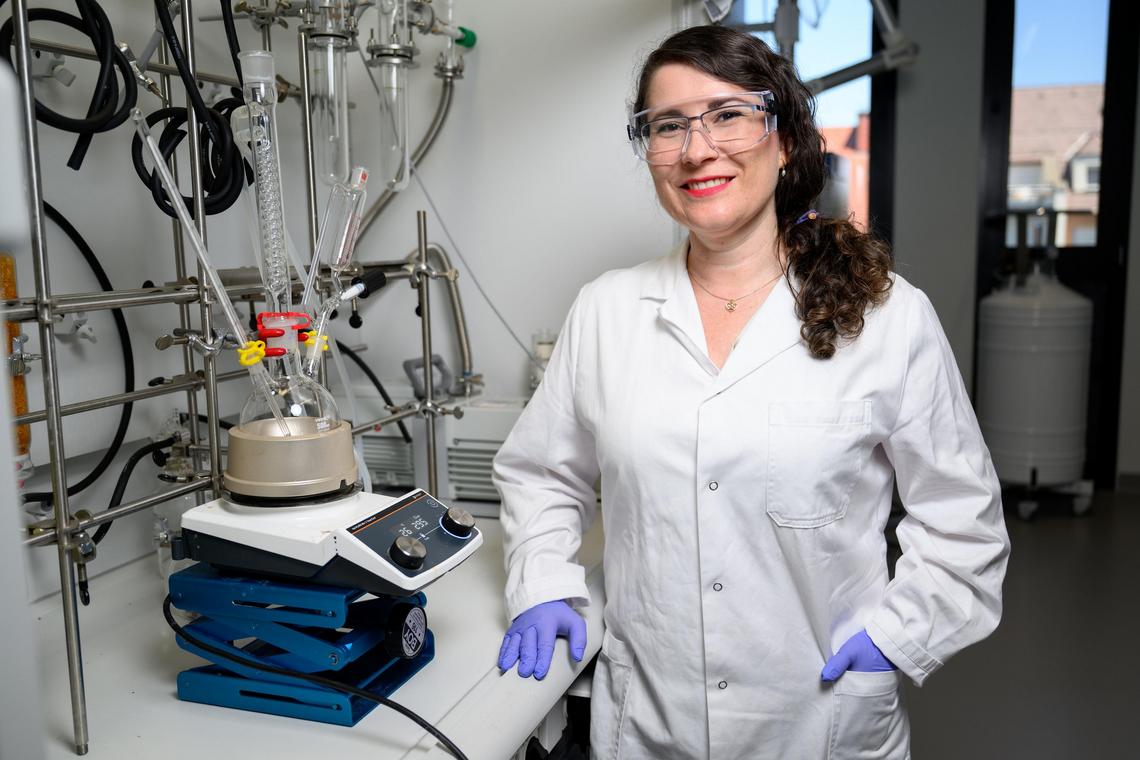
The portrait series opens with Prof.(FH) Priv.-Doz. Dr. Yolanda Salinas, a chemistry researcher at IMC Krems who combines scientific excellence with social responsibility, serving as a role model and inspiring the next generation of women scientists.
Press
Shaping Science with Responsibility
When Curiosity Takes Responsibility
“For me, research is the place where curiosity meets responsibility towards society.”
This conviction underpins the work of Prof. Yolanda Salinas at the Institute of Applied Chemistry at IMC Krems. Her research focuses on translating advances in materials science into tangible solutions for real-world challenges – in medicine, environmental technologies and sustainable materials development.
Functional Materials Designed at the Nanoscale
Yolanda Salinas conducts research at the intersection of biodegradable polymers and nanoparticles. Her work centers on hybrid organic–inorganic nanostructures, stimuli-responsive systems and functional materials for biomedical applications, optoelectronics and environmental technologies.
What particularly fascinates her is the ability to deliberately design materials at the nanoscale to interact with biological systems in a controlled and purposeful manner. Her research bridges cutting-edge nanomaterials chemistry with practical applications, ranging from targeted drug delivery for cancer therapy to adaptive, responsive systems as early diagnostic sensing.
Sustainable Environmental Solutions with Active Nanomaterials
A key focus of her current projects is the development of active, motorized and degradable materials for environmental decontamination, particularly for removing microplastics from wastewater. By combining porous silica nanoparticles with biodegradable polymer components, such as phosphazenes, her team is pursuing a sustainable innovative and dynamic approach towards pollutant capture.
These polymers act as well as a kind of “guidance system”, selectively binding pollutants through a strategy that is literally conceived in motion, combining efficiency with environmental compatibility. Safety, sustainability and the principles of green chemistry are consistently at the heart of all her research activities.
An International Career with a Societal Focus
Yolanda Salinas’ academic journey began in Spain, where she studied Chemical Engineering and completed a PhD in Chemistry. After conducting research on silica-based micro- and nanosensors, she broadened her expertise in anticancer nanomedicine through a Marie Skłodowska-Curie Postdoctoral Fellowship in London.
Since 2015, she has been working in Austria at the interface of polymer chemistry and functional nanomaterials, resulting in numerous peer-reviewed publications, extensive international collaborations, and the completion of her habilitation in Polymers and Materials Chemistry at Johannes Kepler University Linz. In 2025, she was appointed Professor at IMC Krems, where she advances forward-looking materials research with meaningful impact on health-related applications and environmental decontamination.
Women in Science: Diversity Drives Innovation
For Yolanda Salinas, one thing is clear: women in science need environments in which their work is valued and their potential made visible. Mentoring, female role models and cultures that actively promote diversity, flexibility and collaboration are key success factors.
“Such conditions benefit not only women but strengthen the quality and innovative potential of science as a whole.”
She encourages young women and aspiring scientists to trust their curiosity, embrace challenges, and bring diverse perspectives, believing that science thrives on courage, openness, and resilience.
About Yolanda Salinas Soler
Prof.(FH) Priv.-Doz. Dr. Yolanda Salinas Soler (41) is a Professor at the Institute of Applied Chemistry at IMC Krems University of Applied Sciences, where she teaches in both the Bachelor of Science in Chemistry and the Master of Science in Engineering in Sustainable Chemistry and Digital Processing programs and also leads interdisciplinary research on controlled-degradable nanomaterials for biomedical, environmental, and functional applications with a strong commitment to sustainable, socially relevant materials science. She is also a proud mother of a three-year-old daughter, to whom she hopes to serve as an inspiration and role model for the future.
3 Questions – 3 Answers:
Why did you choose a career in science?
My path into science was inspired by the wonder of nanomaterials and the powerful idea that, at the smallest scale, we can create solutions to some of society’s greatest challenges.
What do women in science need in order to succeed?
Supportive, inclusive environments that value women’s contributions and foster diversity, flexibility, and collaboration not only empower women in science but also drive stronger, more innovative research.
Do you have any advice for young women and aspiring female scientists?
Trust your curiosity, resilience, and questioning mindset; stay open to new ideas and view every challenge as an opportunity to grow.