
As a scientific partner, IMC Krems is helping to lay the foundations for the future of virtual and hybrid collaboration – with innovative tools, practical guides and flexible learning opportunities.
News
Successful Collaboration Across Distance
Virtual and hybrid working arrangements have long been part of everyday life for small and medium-sized enterprises (SMEs). However, physical distance is just one of several challenges that can make successful collaboration more difficult. A lack of shared understanding, more difficult social relationships, unclear workflows or declining employee engagement can often have a greater impact on everyday working life than physical separation itself. This is precisely where the international project DIMODI – Dimensions of Distance in Remote, Virtual Collaborations – comes in.
Funded by the European Union through Erasmus+, the project aims to systematically identify the different dimensions of distance in virtual teams and provide companies and employees with practical solutions. The focus is on four closely interconnected dimensions of distance: cognitive, social-relational, operational and engagement-related distance. Based on these findings, the project will develop a digital feedback tool, a practical guide and flexible micro-credential courses for continuing professional development.
IMC Krems Provides the Scientific Foundation
Within the international consortium, IMC Krems is responsible for the Needs and Knowledge Analysis work package, thereby providing the scientific foundation for the project as a whole. Together with the project partners, the research team is developing an empirically grounded model of the four dimensions of distance. This work brings together current scientific findings with the experiences of employees, managers and experts from SMEs. In addition, a comprehensive competence report and the DIMODI practical guide are being developed, providing companies with concrete recommendations for leadership, teamwork and staff development.
“Successful collaboration across distance is not purely a technical issue. What matters is whether employees develop a shared understanding, build strong relationships, coordinate their work and continue to feel like active members of the team. DIMODI combines scientific findings with the practical experiences of SMEs, thereby creating a sound foundation for sustainable virtual collaboration,” emphasises Prof. (FH) Dipl. Verwaltungsw. (FH) Sylvia Rohlfer, PhD, M.A., Project Manager and Professor at IMC Krems.
The consortium is coordinated by the University of Southern Denmark. Further partners include CUNEF Universidad (Spain), Helmut Schmidt University (Germany) and the practice-oriented organisation Work-Live-Stay Southern Denmark. The three-year Erasmus+ project runs from December 2025 to December 2028.
Joint Kick-off at the First Project Meeting in Denmark
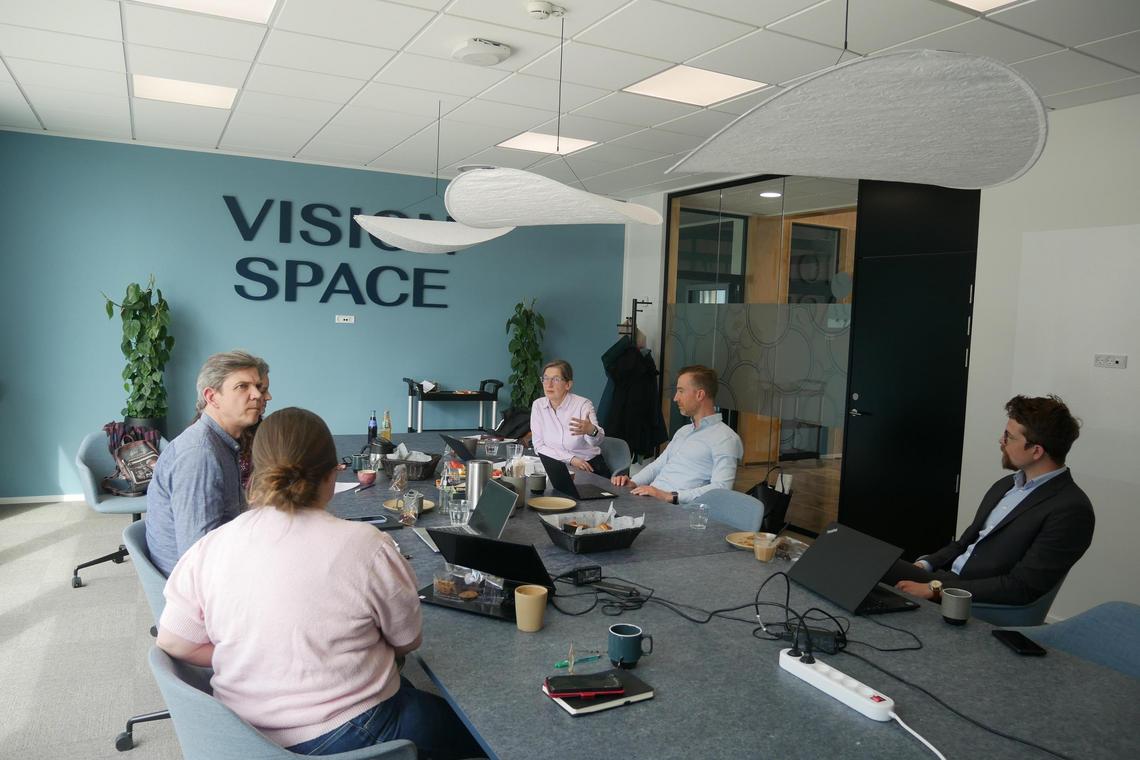
At the first in-person meeting of all project partners in Denmark, the foundations for further collaboration were established. Together, the partners developed a shared understanding of the four dimensions of distance and refined their distinctions. This created a common conceptual framework for analysing 40 interviews already conducted on experiences of virtual and hybrid collaboration.
At the same time, the next steps were defined: analysing the interview data, completing the baseline report and mapping specific individual and team-related competences to the respective dimensions of distance. These results will provide the basis for developing the digital feedback tool and the practical learning opportunities.
Providing Greater Guidance for Companies and Employees
DIMODI helps SMEs make different forms of perceived distance within teams visible and reflect on them in a targeted way. The practical guide translates the scientific findings into concrete measures for effective leadership and collaboration. At the same time, modular micro-credentials enable adults to develop precisely those competences they need for effective, inclusive and sustainable collaboration across distance. The learning opportunities are flexible, practice-oriented and tailored to different working and learning situations.