
Between the International Day of Women and Girls in Science on 11 February and International Women’s Day on 8 March, IMC Krems highlights female researchers who shape science with integrity, curiosity and social responsibility. One of them is Associate Professor (FH) Agnes Wilhelm, MSc – physiotherapist, researcher and lecturer at IMC Krems. Her academic journey demonstrates how research emerges from clinical practice – and why it has its greatest impact where it tangibly improves people’s lives.
Press
Research with Purpose: Science That Moves People
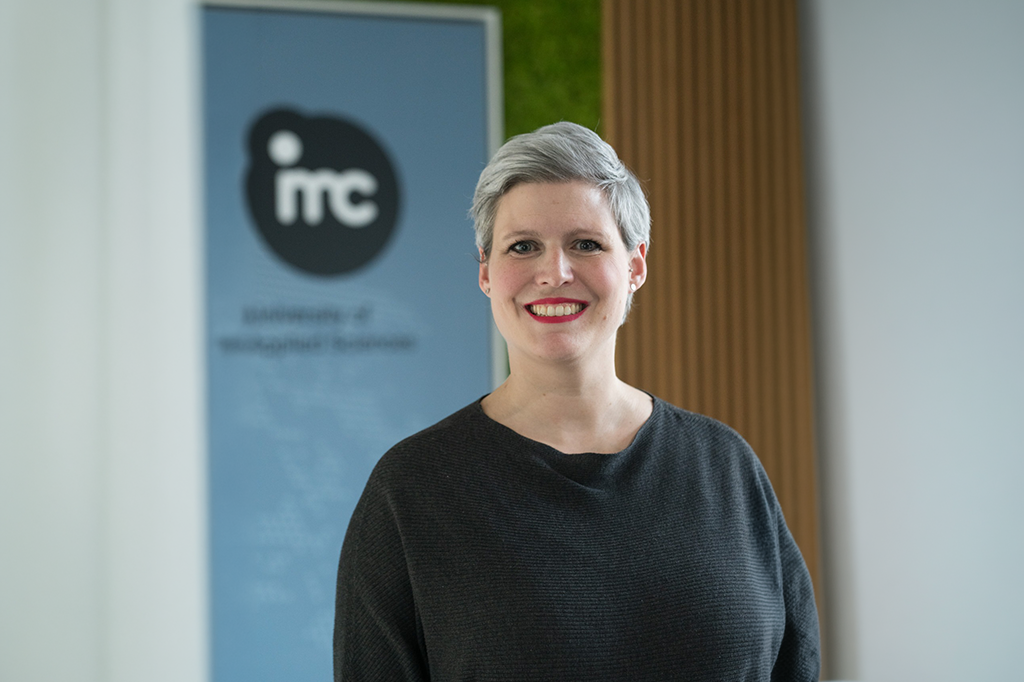
When Experience Becomes a Research Question
For Agnes Wilhelm, research does not begin at a desk, but in contact with patients. Her focus is on Freezing of Gait (FOG) in people with idiopathic Parkinson’s disease – a sudden, brief episode of inability to walk or initiate movement, often occurring during turning or when starting to walk. Although FOG is common in clinical practice, the phenomenon remains insufficiently understood scientifically.
“Research, for me, is curiosity,” says Wilhelm – coupled with the ambition to answer open questions systematically. Her interest in FOG developed through her many years of work in neurological rehabilitation and deepened during her Master’s thesis and initial research projects at IMC Krems. She is particularly fascinated by the complex interplay of neurological structures and its impact on movement behaviour, daily functioning and therapeutic decision-making.
Research with Tangible Benefits
Agnes Wilhelm is currently working on two projects focusing on Freezing of Gait.
In the interdisciplinary project “PreFOG”, gait parameters are recorded using smart insoles and analysed through machine learning techniques. The aim is to identify patterns that enable the early prediction of FOG episodes. The project is conducted jointly by the Institute of Digitalisation and Informatics and the Institute of Physiotherapy at IMC Krems, and is funded by the Lower Austrian Business and Tourism Fund as well as the EU programme IBW/EFRE & JTF.
In the second project, “ID-FOG”, funded by the Lower Austrian Health and Social Fund (NÖGUS) as part of a dissertation call, Wilhelm is investigating whether different FOG subtypes can be identified using mobility tests and questionnaires. The goal is to further develop assessment methods and strengthen evidence-based decision-making in physiotherapy.
Both projects share a clear commitment: research should not remain abstract, but should provide concrete support to patients and health professionals alike.
Research Rooted in Practice
After completing her secondary education, Agnes Wilhelm trained at the Academy of Physiotherapy and worked for several years in neurological rehabilitation. A career break in New Zealand opened up new perspectives. In 2013, she began working as a part-time lecturer at IMC Krems while simultaneously completing her MSc. Her academic career evolved step by step from clinical curiosity and the desire to further develop physiotherapy practice on a solid scientific foundation.
Since 2019, she has been teaching and conducting research full-time as an Associate Professor (FH) at IMC Krems. She also continues to work independently in Vienna and is currently undertaking a part-time PhD programme at the Paracelsus Medical Private University Salzburg.
Research as Dialogue
What drives Agnes Wilhelm is exchange – with people affected by Parkinson’s disease, as well as with students and colleagues. She sees research as a dialogue between scientific knowledge and lived experience. In her teaching, she encourages students to think critically and to ask questions. Good research, she believes, emerges where interest, openness and responsibility come together.
Women in Science: Diversity as a Prerequisite
As part of the focus month “Women in Science”, Agnes Wilhelm speaks openly about necessary framework conditions: women – like all people – need the opportunity to demonstrate their strengths and to develop free from prejudice. Equally important to her is the compatibility of family and career, regardless of individual life models.
Her advice to young women and aspiring female researchers is clear: show interest, ask questions and seek dialogue with those affected. Research should always aim to improve people’s lives. Diversity and different perspectives are not an optional addition, but a prerequisite for good science.
About Agnes Wilhelm
Associate Professor (FH) Agnes Wilhelm, MSc, is an Associate Professor at the Institute of Physiotherapy at IMC Krems. Originally from the Waldviertel region of Lower Austria, she completed her physiotherapy training there and has been working at IMC Krems since 2013, full-time in teaching and research since 2019.
Her academic career includes an MSc in Neurorehabilitation Research from the University for Continuing Education Krems and the Psychotherapeutic Propaedeutic Programme at the Postgraduate Center Vienna. Since 2023, she has been enrolled in the PhD programme in Medical Science at Paracelsus Medical Private University Salzburg. Agnes Wilhelm is a mother of two and lives with her family in Vienna.
Three Questions – Three Answers
Why did you choose a career in science?
Because I want to answer open questions and generate insights that improve therapeutic practice and the lives of those affected.
What do women in science need in order to succeed?
The opportunity to demonstrate their strengths and to grow from their weaknesses – free from prejudice or limitations based on their gender.
Do you have any advice for young women and aspiring female researchers?
Show interest, ask questions proactively, and speak with those affected to understand what truly matters to them. Research should have a positive impact on people’s lives.