
Press

New Polymers for the Analytics of Tomorrow

The POLYOLS project at IMC Krems, led by Prof.(FH) Priv. Doz. Dr. Uwe  Rinner, develops functional materials from bio-based and recycled raw materials for modern analytical applications

Sustainable high-performance materials via novel synthesis pathways

At the Institute of Applied Chemistry at IMC Krems, a novel class of functional polymers is being developed the POLYOLS research project. The aim is to create high-performance materials based on cost-effective aromatic feedstocks as well as recycled waste products. The production process combines biotechnological fermentation with established organic synthesis methods. The project is funded by the Federal State of Lower Austria and co-financed by the European Union.
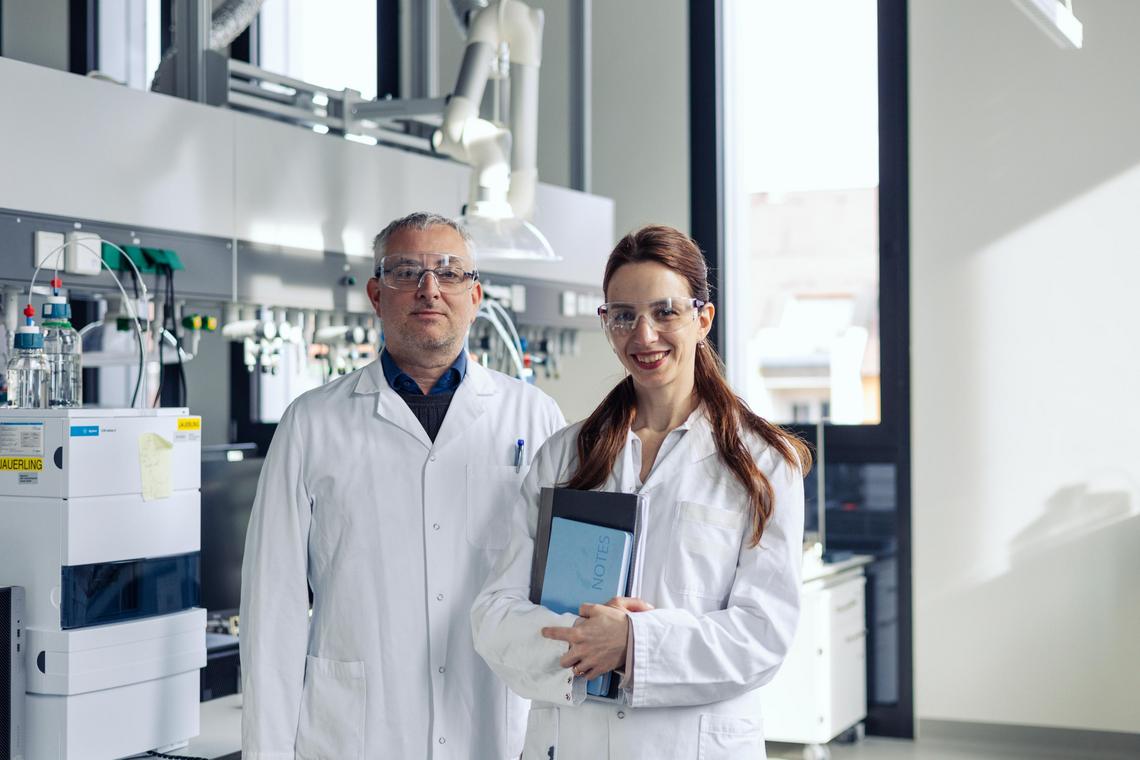
 

Uwe Rinner and Anna Malyshenko are working on the POLYOLS project, developing sustainable, functional polymers for innovative applications in analytical science.

Biotechnology and chemistry in an integrated process

The project’s key innovation lies in linking microbial biotransformation with subsequent chemical processing. Aromatic starting materials are converted by selected microorganisms into cyclohexadienediol structures, which are then further developed into inositols and their derivatives.
These polyhydroxylated molecular structures are characterised by controllable stereochemistry and a high degree of variability in functionalisation. This results in a highly adaptable polymer platform with enhanced thermal and chemical stability.

New materials for demanding analytical applications

A key application area for POLYOLS polymers is instrumental analysis, particularly high-performance liquid chromatography (HPLC). Here, they could be used as stationary phases in separation columns, for example in the analysis of natural products, pharmaceutical compounds or environmental contaminants.
Compared with established materials such as cellulose, the new polymer structures offer greater structural variability and therefore potentially improved selectivity. They are expected to show particular promise in chiral separations and in the analysis of complex mixtures of biologically active substances.

Three work packages from microbial fermentation to application

The project is structured into three closely interlinked work packages:

  • Fermentation of aromatic feedstocks
    In the first step, aromatic compounds are converted into cyclohexadienediols by microorganisms. In addition to established substrates such as bromobenzene, aromatic compounds with functional side chains are also investigated in order to generate specifically polymerisable precursors. Various bacterial strains, including established dioxygenase systems, are used to optimise these conversions.
  • Synthesis and polymerisation of inositols
    Building on the intermediates obtained via fermentation, stereoselective synthesis of inositols is carried out, followed by their conversion into polymers. Controlled reaction conditions and protecting group strategies enable precise adjustment of stereochemistry. Polymerisation is achieved, among other methods, via metathesis-based processes.
  • Evaluation in chromatographic systems
    The resulting polymers are implemented in HPLC columns and evaluated with regard to their separation performance in comparison with commercial standards. In addition, their interactions with proteins are investigated to assess potential applications as selective sensor materials. 

From fundamental research to application-oriented material development

POLYOLS follows an integrated research approach that systematically combines biotechnological and chemical methods. The focus is on developing functional materials that are both structurally tunable and industrially relevant.
In the long term, the results could provide new impetus for analytical chemistry, pharmaceutical quality control and environmental analysis—particularly in areas where high selectivity and material stability are essential.