
News

New methodological toolkit for digital service research published

New IMC Krems publication in Q1 Journal of Service Theory and Practice

Digitalisation is transforming not only markets and businesses but also academic research itself. With the publication of the article “Digital praxiography: a qualitative research toolkit for capturing digital service-related practices” in the renowned Journal of Service Theory and Practice (Q1), IMC Krems, together with international partner universities, is making a pioneering contribution to the advancement of qualitative methods in the digital sphere.

The article was co-authored by Prof.(FH) Mattia Rainoldi, PhD, MSc, BA (IMC Krems) in collaboration with Prof. Dr Adele Ladkin (Bournemouth University), Prof. Dr Dimitrios Buhalis (Bournemouth University) and FH-Prof. Priv.-Doz. Dr Barbara Neuhofer, BA, MA, PhD (FH Salzburg).
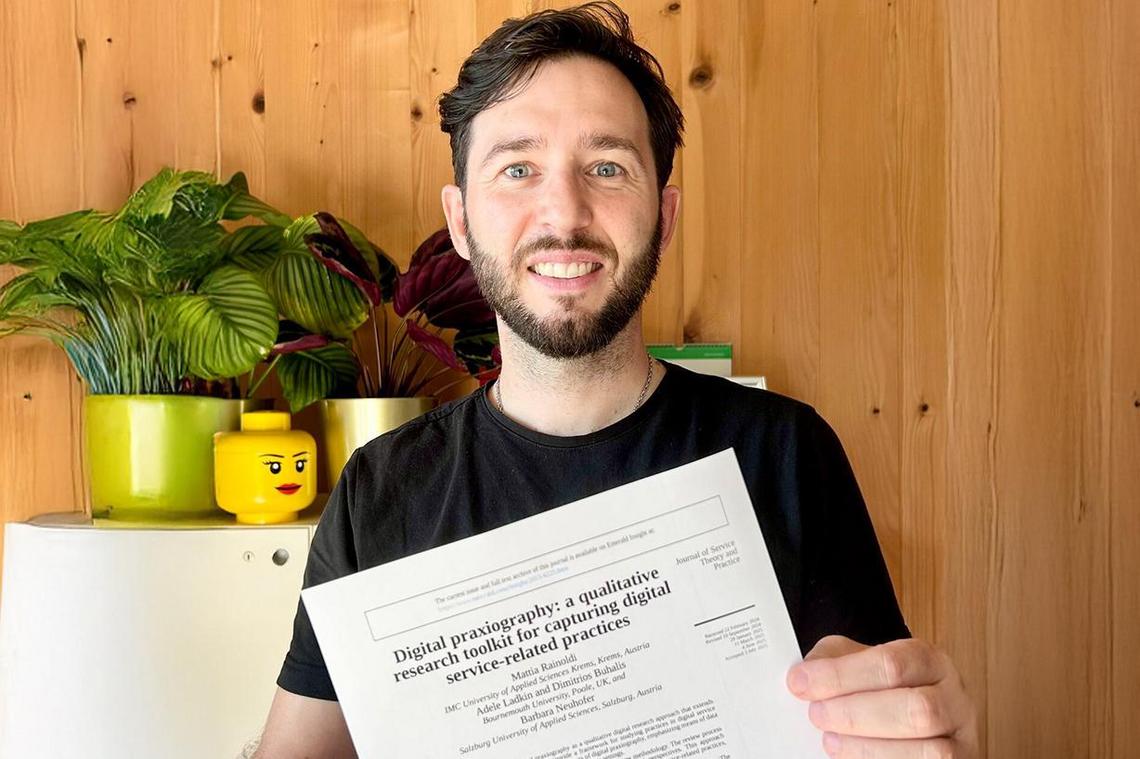
Prof.(FH) Mattia Rainoldi, PhD, MSc, BA (IMC Krems) with his latest publication on Digital Praxiography in the renowned Journal of Service Theory and Practice (Q1) – an innovative toolkit for digital service research.

New paths in qualitative research

At the core of the study is the introduction of Digital Praxiography – a methodological approach that extends classical praxiographic and netnographic principles in order to systematically capture and analyse digital service-related practices.

While netnography has so far mainly focused on digital communities and interactions, digital praxiography opens up a deeper understanding of practical actions, routines and behaviours in digital service environments. This closes a gap in the methodological landscape and provides researchers with a precise toolkit for data collection and analysis in digital contexts.

“Digital transformation requires not only new business solutions but also innovative research approaches to understand and interpret these developments scientifically,” emphasises Prof. Rainoldi. “With digital praxiography, we have developed a tool that fills this gap and opens up new perspectives in both service and tourism research.”

Relevance for research and practice

The concept was developed through an iterative and interpretive review process and combines different theoretical perspectives. The result is a methodology that is highly adaptable – applicable to both purely digital and digitally mediated service environments.

The publication underscores the international visibility and relevance of the research work at IMC Krems. It highlights how the university is actively contributing to shaping the digital future of the service and tourism sector – not only in terms of content, but also at the methodological level.

Read the article: The full paper has been published in the Journal of Service Theory and Practice and is available here:  Digital praxiography: a qualitative research toolkit for capturing digital service-related practices