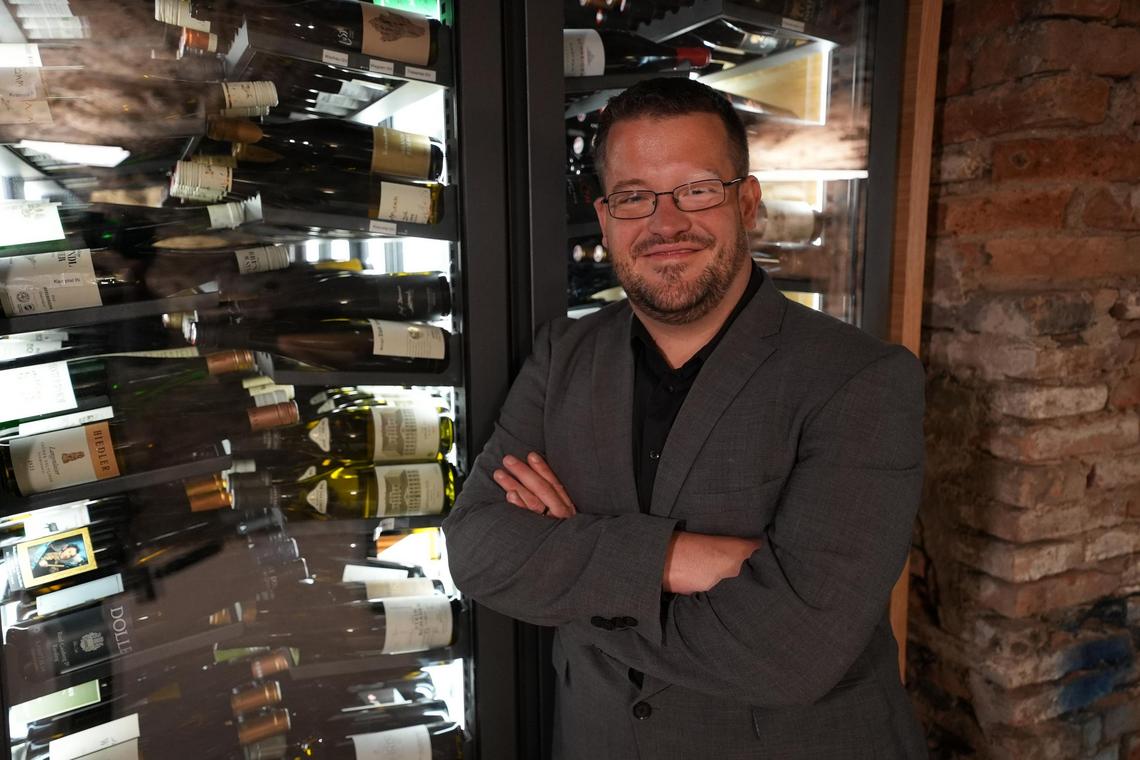
When Markus Eitle talks about wine, there is enthusiasm in every sentence. Yet he is not merely speaking about enjoyment – but about a complex interplay of nature, culture and economics. The research professor at the Institute for Marketing and Wine Business at IMC Krems combines scientific inquiry with economic foresight and social responsibility. His aim: to shape the future of viticulture sustainably.
Press
Living Sustainability, Understanding Wine, Shaping the Future
Between Vine, Climate and Consumption – An Interdisciplinary Path
His academic journey began in horticultural and viticultural sciences. Early on, Markus Eitle was fascinated by the finely tuned system of vine – soil – climate – people – biodiversity. During his doctoral studies, he explored grapevine physiology and host–parasite interactions at the root. Yet the more he learnt about biological processes, the more his interest shifted towards the people who work with and depend on these systems.
“I have always been driven by the question of how we can apply scientific insights in ways that are not only academically relevant but also socially meaningful,” he explains.
This idea continues to shape his research and teaching. At the centre of his work lies the connection between agricultural science, sustainability and economics – with a focus on the wine sector, an industry that embodies culture, innovation and ecological responsibility like few others.
Research for a Future-Proof Wine Industry
As part of his research professorship on sustainability in Austrian viticulture, Markus Eitle is dedicated to key questions of the future: How can viticulture become climate resilient? Which strategies help winegrowers maintain long-term ecological and economic stability? And how can technology and digitalisation support this?
His projects range from studying climate-resilient grape varieties and sustainable soil management to the digital transformation of the wine industry. What matters most to him is that research does not remain confined to the laboratory. “Science only unfolds its full impact once it reaches practice – when winegrowers, businesses and students benefit from it,” he emphasises.
Social issues are also becoming increasingly important. Education, equal opportunities, diversity and societal change in the wine sector have become integral parts of his work. In this way, he contributes to a holistic understanding of sustainability – ecological, economic and social.
Teaching as Dialogue – Research with Students
Markus Eitle sees teaching as a shared process. “Students should not simply absorb knowledge, but think critically, question ideas and actively shape outcomes.” For this reason, he involves them directly in research projects – whether in field studies in vineyards, market research or collaborations with regional businesses.
This close cooperation fosters not only subject-specific competencies but also personal development. The ideas and perspectives of students inspire him time and again. “They bring fresh perspectives to research and remind us that innovation often emerges when we look at familiar things in new ways.”
Research Thrives on its Environment – IMC Krems as an Ideal Location
At IMC Krems, Eitle has found the perfect environment for his interdisciplinary work. Here, viticulture, marketing, tourism and sustainability come together – a unique combination that creates valuable synergies.
Close ties with industry, international exchange and the location at the heart of Lower Austria’s wine regions make Krems a special hub for research. “Here, science is not just something you think about – it is something you can experience directly, in dialogue with businesses, regions and people,” he says, describing the campus atmosphere.
Inspiration from Nature and Culture
Outside the laboratory and classroom, Markus Eitle finds inspiration in nature. Walks through vineyard landscapes, hiking or mindfully savouring a glass of wine are more than leisure activities – they are sources of new ideas. “In nature, you realise what sustainability is truly about: balance.”
Exchanges with winegrowers, colleagues and students also drive him. He sees his research as a contribution to a responsible transition – to a wine sector that preserves tradition while shaping the future.
Balancing Research and Life
Just as reflective as his scientific work is his approach to maintaining a healthy work–life balance. Time with family and friends, good food, and conscious breaks from the digital world help him recharge. “Creativity often arises when you take a step back,” he says with a smile.
With this mindset, Markus Eitle combines academic excellence with mindful living – showing that sustainable thinking is not merely a research topic but a guiding philosophy.