
News

In a race with cancer’s adaptability

Florian Eibensteiner in pursuit of resistance mechanisms

Cancer is not a static adversary. It changes, adapts – and finds ways to evade even modern therapies. It is precisely at this point that the research of Florian Eibensteiner at the Institute of Biotechnology at IMC Krems begins. As a PhD candidate in the TOPICO project, he investigates why some tumours do not respond to treatment – and what role the receptor AXL plays in this process.

“AXL is present at significantly higher levels in many cancer patients than in healthy individuals – particularly in those who do not respond to therapies,” explains Eibensteiner. This knowledge makes the receptor a promising target for better understanding therapeutic resistance – and, in the long term, overcoming it.
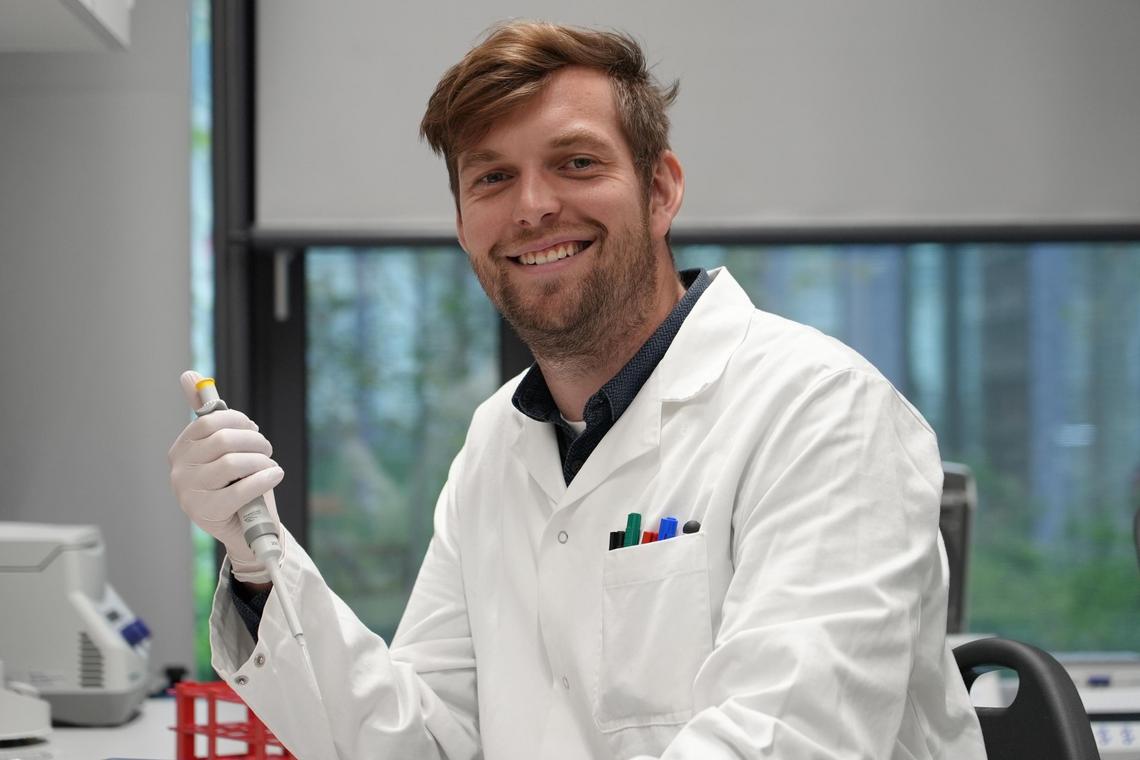
 

On the trail of therapeutic resistance: Florian Eibensteiner is investigating in the TOPICO project how cancer cells evade treatment.

A field of research without standstill

What fascinates him most about this field is its dynamism: while infectious diseases often follow clear patterns, cancer remains a moving target. “Tumours will always find new ways to evade therapies,” says Eibensteiner. It is precisely this unpredictability that makes the research both exciting for him – and highly relevant to society.
One thing is certain to him: there is no standstill in this field of research. Every new insight raises new questions – and that is exactly what drives him forward.

In search of the underlying causes

In his current work, Eibensteiner is investigating why AXL is produced in greater amounts in certain tumours. The focus lies on genetic regulation: which mechanisms lead cancer cells to produce increased levels of this receptor? And how does AXL manage to bypass therapeutic interventions?
To find answers, he works with both tumour tissue from patients and so-called cell lines – cancer cells cultivated in the laboratory. The samples are analysed at both genetic and proteomic levels in order to obtain as comprehensive a picture as possible of the underlying processes.

Research with direct patient relevance

A key component of his work is close collaboration with the University Hospital St Pölten. The inclusion of real patient samples gives the project particular relevance and helps bring research findings closer to clinical application.
His work is embedded in the FWF-funded project “TOPICO – Transformation of Pre-Clinics into Clinics by Organoids”, in which several researchers jointly investigate the receptor AXL and its role in cancer. “AXL is still comparatively under-researched – which is exactly what makes it so exciting to work in this field,” Eibensteiner emphasises.

The path into cancer research

His interest in cancer research developed during his studies. He was particularly drawn to the interdisciplinarity of biotechnology – the combination of biology, chemistry, and engineering. His master’s thesis at the Centre for Cancer Research at the Medical University of Vienna further deepened this interest.
In his search for a suitable PhD position, he eventually came across IMC Krems – and with it a research environment that ideally matches his interests.

Motivation and balance

Eibensteiner finds his motivation primarily in the dynamism of research itself: discovering new things, understanding connections, and building knowledge step by step. Exchange with colleagues and the support of his supervisor also play an important role.
He finds balance away from the laboratory – training with his dog or through his volunteer work with the Red Cross. These activities help him clear his mind and regain energy for the next scientific challenges.
His career path was not always predetermined, as a glimpse into his childhood shows: “I wanted to become a helicopter pilot,” he says. Today, he is convinced he made the right decision – not least because of the diversity and unpredictability of his current profession.

About Florian Eibensteiner

Florian Eibensteiner attended BORG Krems with a focus on the natural sciences and subsequently studied biotechnology at FH Tulln. He is currently a PhD student at IMC Krems, where his research focuses on therapy resistance in cancer, with particular emphasis on the AXL receptor.