
What do international negotiations, diplomatic protocol and the IMC lecture hall have in common? In the case of our alumnus Pascal Mittermayer, the answer is clear: lived practice.
Story
From lecture hall to international diplomacy
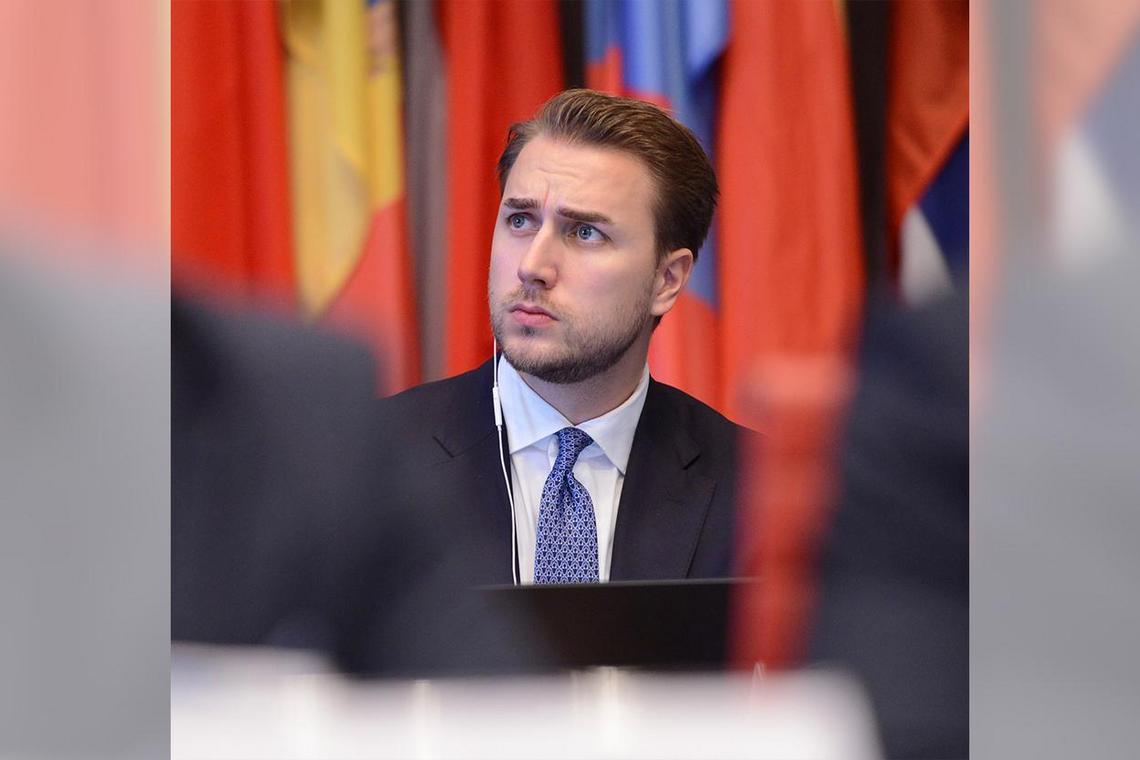
Pascal completed the master degree programme International Business and Economic Diplomacy at IMC Krems University of Applied Sciences and now works internationally – including as a Special Advisor to several OSCE Chairmanships. Since 2024, he has also been sharing his expertise as a part-time lecturer in his former degree programme.
An international career built on a strong IMC Foundation
After completing his studies at IMC Krems in 2022, Pascal’s professional path quickly led him onto the international stage. For more than three and a half years, he has been working in a highly political, multilateral environment.
Since 2024, he has been advising the OSCE Chairmanships of Malta (2024), Finland (2025) and Switzerland (2026) on economic, environmental and security-related issues – in close collaboration with 57 participating States, as well as international organisations, the private sector and civil society actors.
What sets him apart:
- a strong international focus
- daily work in multilateral and multicultural contexts
- a well-developed understanding of diplomacy, hierarchies and cultural codes
He now brings this experience back to his alma mater.
Alumni as lecturers: Bringing practice into the classroom
As a lecturer in Diplomatic Protocol within the master programme International Business and Economic Diplomacy, Pascal combines theory with real-world insights from international practice.
His course covers, among other things, modern diplomatic protocol and etiquette, intercultural communication and competence, the role and importance of hierarchies, rules and social codes, as well as the practical impact of behaviour, manners and protocol in international contexts.
For students, this means learning from someone who works in this exact environment every day – and for whom IMC Krems itself was an important starting point.
Why “Alumni as Lecturers” are so valuable for IMC Krems
Graduates like Pascal, who return as lecturers, are a prime example of the IMC model: a practice-oriented education, international career paths, and the transfer of knowledge back to the university.
They show students in concrete terms where an IMC degree can lead – and make teaching tangible and up to date. Or, in other words: when alumni teach, the circle is complete.
Three questions for Pascal Mittermayer
How did your studies in “International Business and Economic Diplomacy” at IMC Krems prepare you for your current international role?
My studies at IMC Krems prepared me for my current role in many ways – not only academically, but especially through the practical application of soft skills in an international environment.
A key foundation was English as the working and study language. Using it daily in lectures, group work and presentations, as well as engaging academically with complex subject matter, gave me the confidence I need today in multilateral negotiations and when drafting dossiers.
Equally formative was learning to manage time as a critical factor and to focus on what truly matters. In my professional life, I often have to draft speeches and position papers for ministers, high-level representatives or multilateral negotiations under considerable time pressure. This is where I realise how valuable my studies were, not only in terms of knowledge gained, but particularly in developing the ability to communicate complex content clearly, concisely and in a targeted manner.
Working in international and multicultural teams was also particularly influential. Fellow students from Hungary, Pakistan, India and Australia brought different perspectives and working styles. You learn to identify shared priorities and develop solutions that work for everyone – a skill I now apply every day in my work with 57 OSCE participating States.
My studies at IMC Krems also fostered a deep sense of curiosity, not just academically, but also culturally and intellectually. In a time when AI increasingly takes over routine tasks such as research, data summarisation or calculations, this curiosity and the ability to understand complex interconnections are becoming ever more important. Machines can provide facts and automate processes, but responsibility for decisions, critical thinking, contextual understanding and the ability to bridge different worlds remain essential human strengths. These skills are particularly crucial in international diplomacy, where there are often no clear solutions, but rather trade-offs, compromises and creative thinking are required.
You now teach Diplomatic Protocol: what experiences from your professional life directly feed into your teaching – and why is this particularly valuable for students?
In our Diplomatic Protocol course, we not only introduce students to the theoretical fundamentals, but above all aim to encourage critical engagement with topical issues through real-life examples – particularly in light of the increasingly central role of the media. This is the greatest added value for students.
Classic examples include state visits by US presidents. Here, we analyse how protocol rules are applied in practice – or (deliberately) broken – and what political and diplomatic consequences may arise.
Even more valuable, however, are examples from our own professional experience that are not found in textbooks. Situations where there is no clear “best practice”, where improvisation and creativity is called for.
We share these challenges with students not as ready-made, one-size-fits-all solutions, but as thought-provoking inputs. Together, we work on fictional yet realistic scenarios to develop problem-solving skills. This is particularly valuable because it allows students to directly appreciate the benefits of flexibility and creativity, coupled with intellectual and cultural curiosity, and to understand that diplomacy is often not a rigid set of rules, but a dynamic process that requires adaptability.
What does it mean to you personally to return to IMC Krems as an alumnus and support students on their path towards international careers?
When I was studying at IMC Krems myself, I would not have expected to move from the private sector into the multilateral world within such a short time, let alone to teach Diplomatic Protocol. Back then, my career path, mostly shaped by a variety of projects in the private sector, was still very much unclear. That is precisely what makes it so special for me to return as a lecturer today.
My interest in international diplomacy and politics has always been strong, but due to the lack of direct context and contacts, it wasn’t really “tangible”. During my studies, including through the Diplomatic Protocol course, as well as through the pandemic and the very tangible impact of global interconnections, this interest grew significantly.
All of this deepened my motivation to engage with multilateral cooperation and global challenges.
The fact that I am now able to work precisely in this context, and teach this very subject, and thereby perhaps – consciously or unconsciously – inspire some students to pursue a similar path, is a great honour and a real pleasure for me.