
How can companies strengthen their capacity for innovation in the context of sustainable development?
This was the question addressed by an international research team comprising Prof. (FH) Dipl.-Verwaltungsw. (FH) Sylvia Rohlfer, PhD, M.A. (Institute of Business and Innovation, IMC Krems University of Applied Sciences), Prof. Simon Jebsen (University of Southern Denmark) and Prof. Abderrahman Hassi (Al Akhawayn University Ifrane, Morocco).
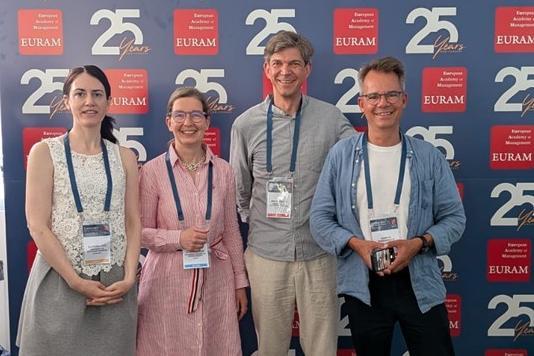
The findings were presented at the prestigious European Academy of Management Conference (EURAM) 2025.
News
Empowering Leadership as a Key to Sustainable Innovation
Focus: Middle Management as a Driver of Innovation
The study examined over 450 small and medium-sized enterprises (SMEs) in Morocco – a country which, like many emerging economies, relies heavily on innovation initiatives from its middle management.
The key finding: The leadership style of senior management significantly influences how willing and able middle managers are to innovate.
Particularly effective in this regard is the concept of Empowering Leadership – a leadership approach that delegates responsibility, fosters initiative, and actively encourages participation in decision-making.
Two Key Insights for Practice
- Empowerment requires active listening
Delegating responsibility alone is not enough: middle managers must feel that their voices are heard. Only when ideas, suggestions for improvement, and critical feedback are actively sought out and taken seriously can innovation take root in everyday working life. - Empowerment does not work equally for everyone
The positive effect is strongest among managers who identify closely with their role and have a collectivist orientation – that is, those who prioritise the well-being of the team over individual interests.
Relevance for Business and Education
The results show that leadership development should not be approached with a “one-size-fits-all” mentality.
Targeted leadership training that takes individual personality traits into account is crucial.
Moreover, middle managers should not be seen merely as a link between senior management and employees – but as a strategic lever for change and sustainability.
Conclusion
“Middle managers are the underestimated engine of sustainable innovation,” emphasises Sylvia Rohlfer.
Companies that actively promote empowering leadership gain more than just new ideas – they set real change processes in motion.
The study underscores that empowering leadership is not a “soft skill”, but a strategic success factor for ensuring the long-term viability of companies.