
The CAST Mozambique project was presented to an international audience at the 75th AIEST Conference in St. Gallen. Prof. (FH) Dr Alice Wanner presented the project’s capacity-sharing approach and demonstrated how higher education can strengthen local communities and contribute to sustainable rural tourism development.
News
CAST Mozambique presents international approach to sustainable rural tourism
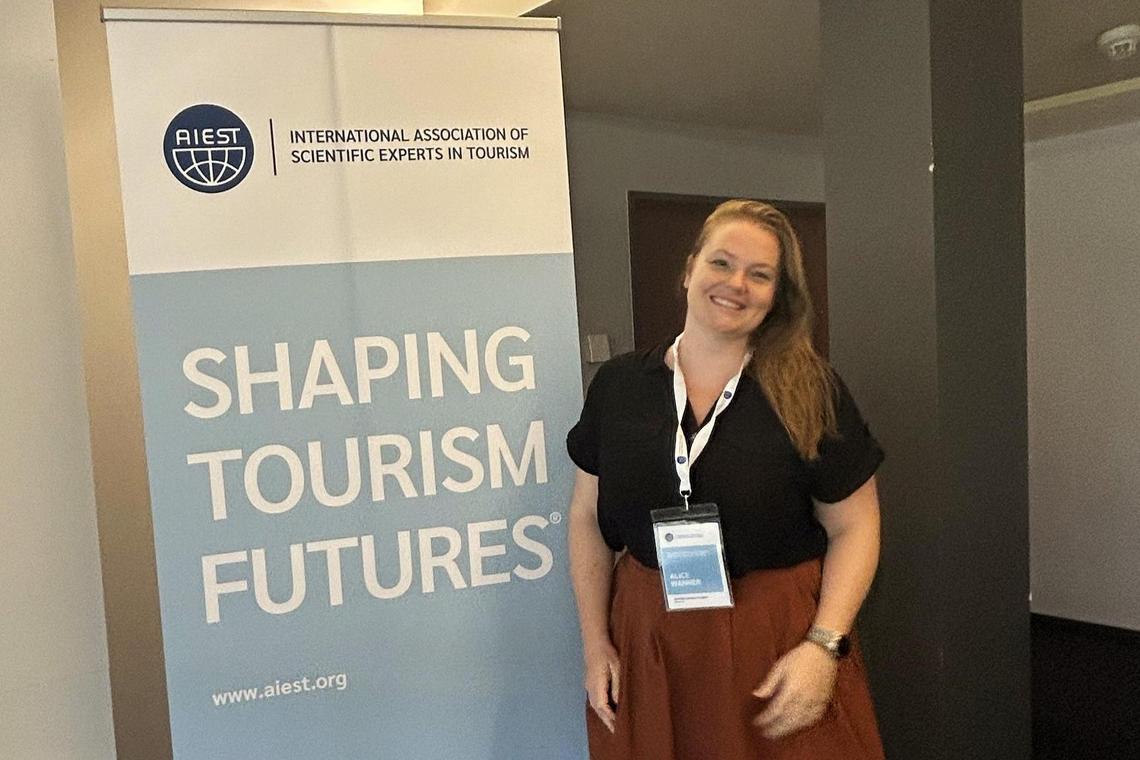
CAST Mozambique takes centre stage internationally
From 23 to 26 August 2026, the 75th conference of the International Association of Scientific Experts in Tourism (AIEST) brought together international experts from tourism research and practice in St. Gallen. The anniversary conference took place in the city where the association was founded 75 years ago.
Alice Wanner represented IMC Krems and the CAST Mozambique project with the presentation “Bridging the Gap: Boosting Sustainable Rural Tourism Through Higher Education in Mozambique”. At the heart of the presentation was the question of how higher education can make a targeted contribution to unlocking the potential of rural regions and promoting more sustainable and inclusive tourism development.
Higher education as a key to sustainable development
Tourism in Mozambique is currently concentrated primarily in coastal regions. At the same time, the country’s rural areas have significant cultural and natural potential that remains largely underutilised for tourism. Limited specialised higher education opportunities and insufficient links between academic institutions, the tourism industry and rural communities, however, make it more difficult for local populations to participate in tourism development.
This is where CAST Mozambique comes in: the project connects higher education with the practical realities and knowledge of rural communities. As part of the partnership between IMC Krems and Universidade Eduardo Mondlane and its Escola Superior de Hotelaria e Turismo de Inhambane, new courses and a Master’s programme in Sustainable Rural Tourism are being developed.
This will enable students, educators and local stakeholders to acquire the skills they need to jointly develop sustainable tourism products and appropriate digital marketing strategies.
Capacity sharing based on four pillars
The CAST Mozambique model presented at the AIEST Conference is built around four interconnected pillars: a comprehensive needs assessment, a train-the-trainer approach, innovative teaching methods and the active involvement of rural stakeholders.
The needs assessment identifies the existing skills of educators and students and aligns them with the requirements of higher education, the labour market and rural communities. Train-the-trainer measures strengthen the teaching, research and administrative skills of university staff in Mozambique. Innovative teaching methods link academic content with the practical challenges of sustainable rural tourism.
The involvement of local communities plays a particularly important role: learning extends beyond the classroom. Through field-based experiences, students gain practical insights into the realities of life in rural regions. Rural communities, as well as producers, are not merely regarded as target groups, but are actively involved in developing teaching content, practice-oriented learning activities and tourism planning.
International visibility and professional exchange
The presentation at the AIEST Conference provided an opportunity to discuss the CAST approach with international tourism experts, receive professional feedback and further raise the project’s profile within the international tourism research community.
The conference contribution was jointly developed by Claudia Dolezal, Hélsio Azevedo, Daniel Zacarias, Sónia Cossa and Alice Wanner, highlighting the partnership-based nature of the project. The mutual exchange of knowledge and experience between Austria and Mozambique forms an important foundation for the long-term impact of the collaboration.
In the long term, CAST Mozambique aims to strengthen local ownership, create new income opportunities in rural areas and promote more balanced tourism development beyond the country’s coastal regions.
CAST Mozambique is an APPEAR Academic Partnership Project supported through the APPEAR programme, funded by Austrian Development Cooperation and implemented by the OeAD.