
Story

AI is changing the rules. People make the difference.

For more than 20 years, IMC alumna Maria Agnes Mayer has experienced technological transformation at first hand while working at Microsoft. In recent years, as Senior Director, Global Commercial Business Strategy & Go-to-Market, she was responsible for the strategic and commercial direction of a multi-billion-dollar business division.

Since September 2026, she has returned to Austria after more than a decade abroad. In this interview, she shares her perspectives on artificial intelligence, global leadership, future-focused skills, and why human capabilities matter more than ever in times of rapid technological change.
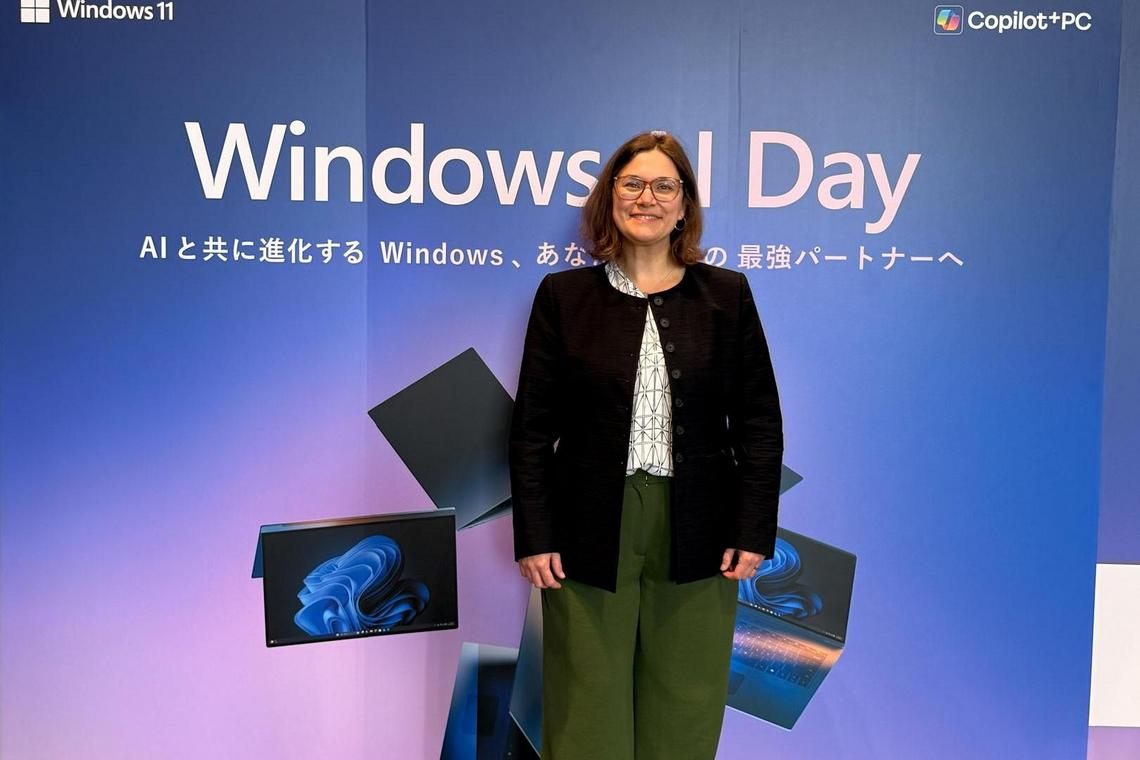
Maria Agnes Mayer
"When the world around us is constantly changing, clarity of purpose and a commitment to learning become the foundations of lasting success," says Maria Agnes Mayer.

Artificial intelligence is transforming the world of work. But which skills will really matter in the future?

Artificial intelligence is rapidly evolving from a technology trend into a fundamental force reshaping the workplace. Organisations are rethinking processes, creating new roles, and reassessing established ways of working. While many focus on the possibilities of new technologies, Maria Agnes Mayer has spent years exploring how organisations can successfully navigate change and bring people along on that journey.

As a graduate of the diploma programme Export-oriented Management (now International Business and Economic Diplomacy), she began her career in consulting before joining Microsoft in 2004. What started as a role in marketing and partner management in Vienna developed into an international career spanning numerous leadership positions and ultimately taking her to the United States. Until recently, she worked in Redmond, near Seattle, as part of the global leadership team of one of the world's leading technology companies.

Leading in a world of constant change

Over the past two decades, Maria Agnes Mayer has been closely involved in multiple waves of technological transformation. From major Windows product cycles and corporate digital transformation initiatives to today's developments in artificial intelligence, her mission has remained remarkably consistent: providing direction, connecting strategy with execution, and uniting people behind a shared vision.

Today, she is responsible for the European business strategy and go-to-market activities for Microsoft's multi-billion-dollar Windows and Surface commercial business. In this role, she collaborates with sales teams, partners, manufacturers, systems integrators, and senior executives across the globe. One of her key strengths lies in identifying market and customer signals early, simplifying complex issues, and aligning organisations around common goals.

These capabilities have been particularly valuable during periods of significant change. Throughout her career, she has led global go-to-market strategies for the Windows ecosystem, supported organisations and partners through profound market shifts during and after the COVID-19 pandemic, and directed international change management initiatives within Microsoft.

Technology needs people

Looking at Maria Agnes Mayer's career, one theme becomes immediately apparent: success is never driven by technology alone. What truly matters is the ability to mobilise people, organisations, and partner ecosystems. Throughout her leadership roles, she has managed global teams across the intersection of sales, marketing, product development, and strategic planning. Her work has consistently focused on enabling growth, introducing innovative business models, and fostering international collaboration across countries and cultures.

Her career provides a compelling example for students and graduates alike. Beyond technical expertise, adaptability, continuous learning, and intercultural competence have become essential qualities. In the age of artificial intelligence, these capabilities are only becoming more important.

Returning to Vienna with a global perspective

After many years in the United States, Maria Agnes Mayer recently relocated to Vienna with her husband and two children. Yet her international perspective remains an integral part of both her professional and personal life.

For her, returning to Austria combines the best of two worlds: being closer to family and home while continuing to work daily with colleagues, partners, and leaders from around the globe. In this respect, she represents many IMC alumni who build international careers while maintaining strong ties to their Austrian roots.

Our interview with Maria

You have spent many years in senior leadership roles at a global technology company. Artificial intelligence is currently transforming business and society at an unprecedented pace. What does responsible and value-creating use of AI mean from your perspective?

For me, responsible AI starts with a clear focus on people. Technology should empower teams, not replace them, and trust and transparency must be built in from the outset. In my role, I see every day that real value is created when AI strategy is closely linked with strong leadership, effective governance, and an AI-first mindset across the organisation. It is equally important to actively involve employees in the transformation process and equip them with meaningful skills rather than imposing change from the top down.

Many students and graduates wonder which skills will be most valuable in the years ahead. What capabilities will people need in the age of AI, and which qualities should IMC alumni actively develop?

AI makes specialist knowledge available at the touch of a button, or a prompt. I know interns who have taught themselves marketing strategy and campaign planning and then configured AI tools to handle much of the day-to-day execution.

As a result, expectations of employees are changing. Critical thinking, a willingness to learn, systems and process thinking, and the ability to bring people together are becoming increasingly important. Based on my experience, I would encourage IMC alumni to invest in leadership skills, emotional intelligence, strong communication abilities, and a commitment to lifelong learning. Those who learn to use technology as a thought partner for strategic decision-making, rather than as a substitute for thinking, will have a clear advantage in the AI era.

After many years in the United States, you recently moved back to Vienna with your family. How have you experienced this transition, and what opportunities does such a fresh start create for family life, career development, and personal growth?

We are still very much in the middle of the process. Returning home initially sounds like coming back to something familiar, and perhaps we romanticised the move a little, shaped by many wonderful visits over the years. Everyday life, however, is something quite different.
As we are only a few weeks into this transition, the first challenges have naturally been practical and organisational.

Gradually, though, it is becoming clear that managing change consciously is just as important in private life as it is in business, and that everyone involved, especially our children, needs to be brought along on that journey. My husband and I are fortunate to have supportive professional environments, which is by no means something to take for granted. It is important to create time to slow down, reflect, and process all the changes step by step. That helps ease the reverse culture shock and, after three, six, or nine months, turns a place into home again.

How can leaders unite people behind a shared vision and strategy during times of significant change?

Artificial intelligence has dramatically accelerated the pace of change. Some believe that planning and strategic direction therefore become less relevant. I would argue exactly the opposite: people and organisations have never needed clarity of purpose more.
What changes is how we plan, not whether we plan. Set a North Star, choose clear strategies, remain flexible in execution, and adapt continuously to changing circumstances.

Most importantly, organisations need consistent and precise communication about goals and progress, combined with a strong emphasis on culture and clear expectations. This creates an environment where experimentation and learning are encouraged, and confidence in positive change can grow.

Because when the world around us is constantly changing, there is still clarity about what success ultimately means, and when learning remains at the centre, people and organisations can continue to achieve remarkable things.

International Business and Economic Diplomacy