
Drought, reduced yields and an earlier harvest start: in some wine-growing regions, harvesting has already begun in mid-August, significantly earlier than in many previous years. The effects of climate change are clearly being felt across the European wine industry in 2026, and in Austria the situation is particularly severe in some areas.
Press
A vintage under pressure
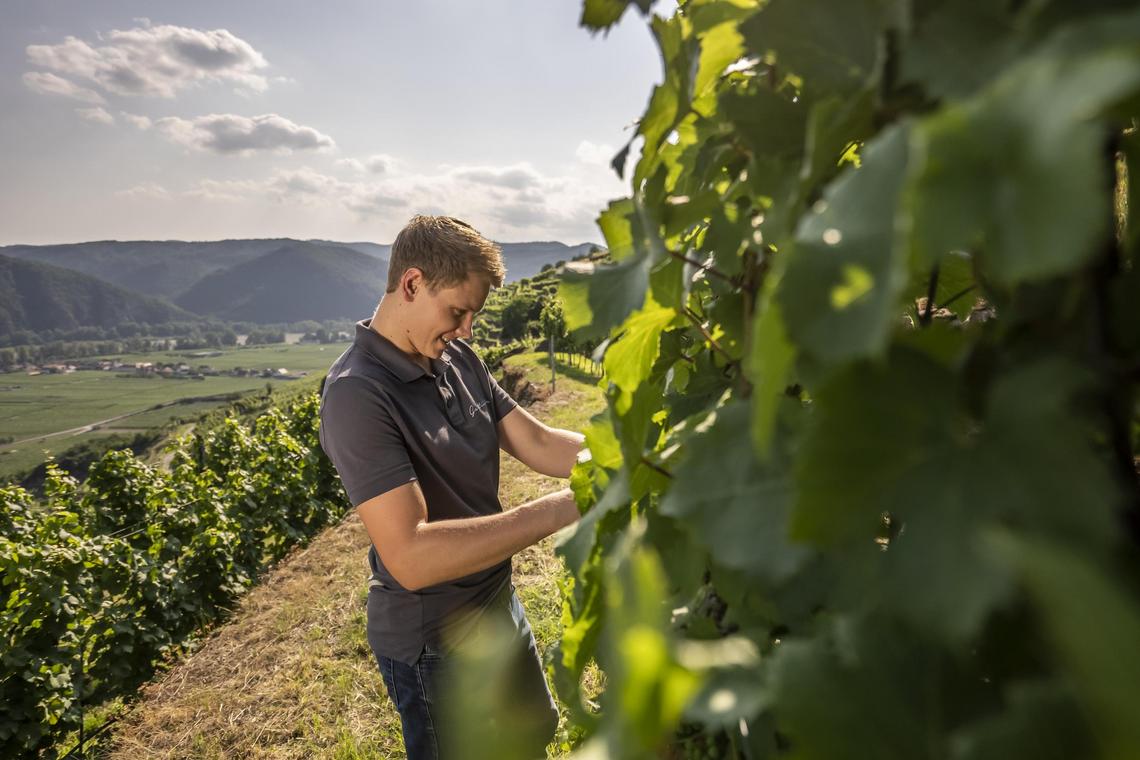
To explore how the sector is responding to these new challenges, we spoke to students, alumni and lecturers from International Wine Business. The bachelor degree programme at IMC Krems addresses topics such as sustainable viticulture, climate change and future scenarios for the wine industry. “We combine theory with practical vineyard training,” explains Head of Programme Albert Stöckl. Students learn about the physiological causes and visible symptoms of drought stress, as well as its short- and long-term effects on berry development and vegetative vine growth. Vineyard-focused soil science modules also cover measures to improve water retention.
Timing is everything: finding the perfect harvest date
One graduate of the International Wine Business programme is Anna van der Niepoort from Weingut Dorli Muhr, a wine-growing region that ranks among Austria’s driest even in average years:
“At Spitzerberg, we are accustomed to harsh and dry conditions, but this year we are feeling them more strongly than usual. At the same time, harvesting is likely to begin earlier than ever before. This creates an additional organisational challenge because many harvest workers are still on holiday at that time.”
Water availability is also under pressure in the Wachau, according to Simon Gattinger. For the winemaker from Unterloiben, it is now crucial to “identify the optimal harvest date in order to preserve the freshness, acidity and regional character of Wachau wines.”
Bachelor’s theses on rising alcohol levels and under-vine management
Six different bachelor’s theses within the programme are currently examining how Austrian wineries are dealing with increasing alcohol levels. Higher temperatures, more sunshine hours and more frequent heatwaves accelerate sugar accumulation and acid degradation in grapes, while optimum aromatic and physiological ripeness does not always develop at the same pace. This growing imbalance presents winemakers with challenges when selecting the ideal harvest date and is reflected in increasingly earlier harvests.
Under-vine management is also being researched at IMC Krems, particularly under-vine cover cropping as an adaptation measure for drought, erosion and late frost.
Smaller harvests due to heat and deliberate yield reduction
One thing is already clear: the 2026 harvest in Austria will begin significantly earlier than in an average year and is likely to be smaller than in 2025. In many regions, the grapes are smaller and have thicker skins due to prolonged heat. Deliberate yield reduction measures aimed at helping vines withstand dry periods have reduced volumes even further.
In Krems, winemaker and alumnus Chris Sciacca from Kapitel Zwei Wine is taking a number of innovative approaches: “Here in Krems, we are around 63 millimetres below average rainfall levels. To support the vines as effectively as possible, I rely not only on yield reduction and cover crops but also on sheep wool to retain moisture in the vineyard. It acts like a sponge, storing water and gradually releasing it again. When soil becomes extremely dry and rain finally arrives, it cannot absorb the water quickly enough, meaning it never reaches the vine roots.”
Chris Sciacca now also teaches part-time at IMC Krems, allowing him to share these experiences directly with students. He brings extensive practical expertise in wine marketing, including through the pop-up wine bars he established in Paris and Vienna-Hietzing.
Looking beyond Austria: the situation in North Macedonia
An international perspective comes from Bojan Ristov of Lazar Winery in North Macedonia, also an IMC alumnus. While hot summers have long been common in the region, June and July 2026 were surprisingly moderate compared with much of Central and Western Europe. The intense heat only arrived in August. “Although temperatures have now become very high, we expect the 2026 vintage to produce exceptional, potentially outstanding wines. A warm vintage does not automatically mean a poor one. What matters is how the vines respond to the conditions and how precisely we manage the harvest and subsequent winemaking process.”
Earlier harvesting has also become an important tool in Tikveš, one of North Macedonia’s most significant wine regions, helping producers preserve freshness and acidity. “This approach is particularly important in light of changing market preferences. Consumers are increasingly interested in fresh, elegant and balanced white wines.”
“It’s all about timing and intuition”
Back in Austria, vineyards in the Kamptal are also struggling with the ongoing drought, according to Marie Hirsch of Weingut Hirsch: “The older vineyards remain remarkably healthy and green. In younger vineyards, some of the grape bunches were removed to protect the vines. We generally work with shorter canopies and, in vineyards affected by the 2024 frost, we apply later pruning, which allows for a later harvest. More important than ever is selecting the optimal harvest date, and we are giving considerable thought to pressing decisions as well.”
The situation is similarly challenging in eastern Weinviertel. Alumna Benita Lobner from Weingut Lobner in Mannersdorf explains: “I have never experienced a vintage like 2026. The first hot vintage in which I was actively involved was 2018, but there was rainfall shortly before harvest. We are hoping for the same this year.” A combination of experience and innovation is proving invaluable. “It is all about getting the timing right and having a feel for the vines. In younger vineyards, we drastically reduced yields, and newly planted vines had to be watered by hand.”
Is irrigation the answer?
In many parts of Austria, viticulture would no longer be possible without a regular supply of water. Andreas Schachenhuber from Weingut WeinSchach, who also teaches part-time at IMC Krems, views this development critically. “When rainfall fails to arrive, even winemakers can only do so much. The key challenge is learning how to retain water in the landscape throughout the year rather than allowing it to drain away as quickly as possible. I am critical of long-term irrigation using groundwater. Vines can cope surprisingly well with drought. We need to rethink how we manage water in our vineyards, our cities and our society. California provides a clear example of how water management has become an integral part of long-term agricultural planning.”
According to Andreas Schachenhuber, the wine industry reflects broader societal change, including shifting consumer behaviour and growing demand for reduced-alcohol and alcohol-free products. “Change is part of entrepreneurship. Our task is not to respond with inertia, but to develop new products, new positioning strategies and new ways of reaching consumers.”
This is precisely where the International Wine Business programme comes in, combining viticultural knowledge with business, legal and management expertise. The carefully balanced mix is increasingly important, allowing different disciplines to work together just as effectively as the various elements currently required in the vineyard.
International Wine Business bachelor degree programme
The right blend makes all the difference. International Wine Business combines a solid business education with viticulture, oenology and legal studies, all taught in English. The programme is unique in bringing together these disciplines within a single bachelor's degree. Students range from aspiring winemakers across Europe to international career changers seeking opportunities in the wine and beverage industry or a business degree with a distinctive focus.
Applications for the 2026/27 academic year remain open until 1 September.
- Full-time study, 6 semesters, 180 ECTS
- Tuition fee: EUR 363.36 (for EU citizens)
Key areas of study
- Fundamentals: business administration, economics, languages and communication
- Practical placement semester in Semester 5
- Specialisations: viticulture and wine production, grape varieties and wine styles, international wine law, wine sensory analysis and analytics

