
What happens when a single molecular switch in our cells spirals out of control? For Alexandra Tsal-Tsalko, MSc, this very question is the starting point of her research at the Institute of Biotechnology at IMC Krems. At the centre of her work is the receptor Axl, which plays a crucial role in many types of cancer. “Axl is significantly involved in enabling cancer cells to grow and survive,” explains the doctoral researcher.
Her goal is to specifically block this receptor while simultaneously identifying the molecular partners it interacts with inside the cell. Only by understanding these complex networks can new approaches for future therapies be developed.
News
Between Cell Signalling and the Future of Cancer Therapy
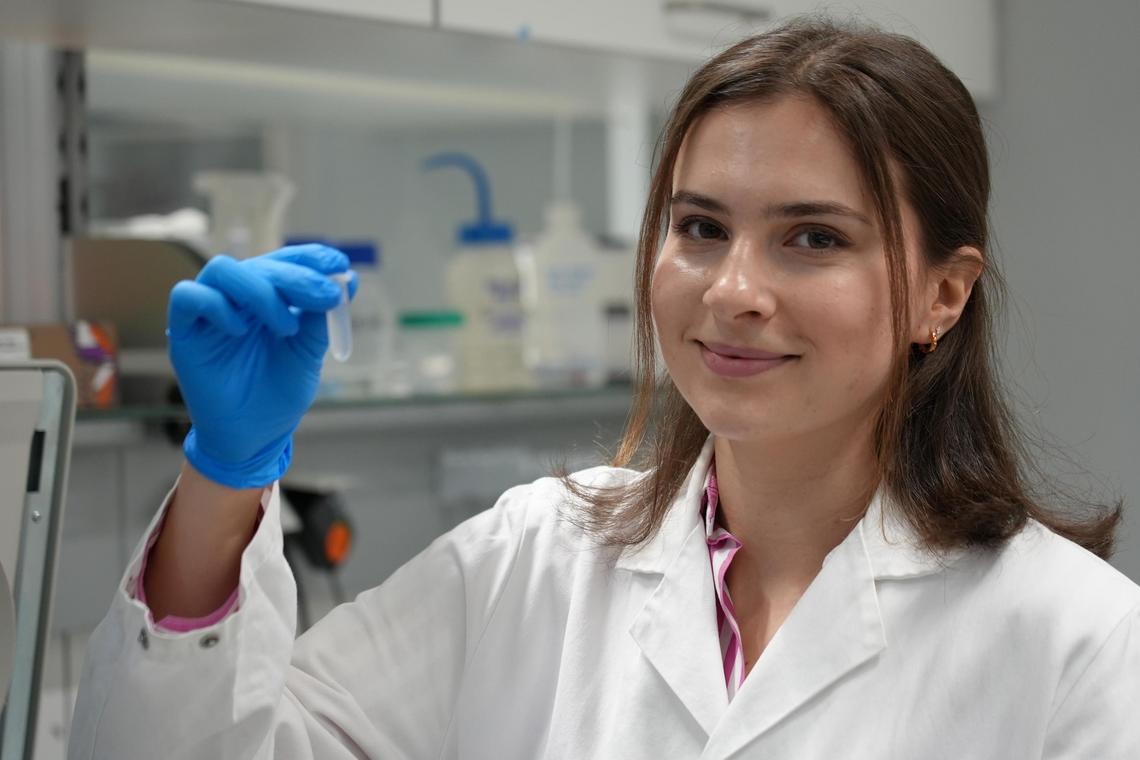
When One Receptor Controls Entire Systems
Tsal-Tsalko is particularly fascinated by the complexity of biological systems: “I find it extremely impressive that the activation of a single receptor can influence so many different signalling pathways within a cell.”
In her current project, she investigates how skin cancer cells – so-called melanoma cells – change when the Axl receptor is switched off. By analysing the protein expression of these cells, she is gaining new insights into the underlying mechanisms.
At the same time, she supervises a master’s thesis pursuing an innovative approach: producing an Axl inhibitor using yeast cells. One particular success remains especially memorable to her: “The first time I successfully produced an inhibitor was an incredibly defining moment – finally seeing the results of months of work in black and white.”
Research Through Collaboration: The TOPICO Project
Her work is embedded within the FWF-funded project “TOPICO – Transformation of Pre-Clinics into Clinics by Organoids”. Together with an interdisciplinary team from IMC Krems and the Medical University of Vienna, she investigates the role of Axl in tumour development and, in particular, in therapy resistance.
What makes the project unique is the collaborative environment: several doctoral candidates and experienced researchers are working on the same receptor in parallel and continuously exchanging ideas. “This close collaboration and the combined expertise make the project truly unique for me,” says Tsal-Tsalko. The findings could contribute in the long term to the development of new and more effective cancer therapies.
The Path into Science
Choosing a career in research was a conscious decision for her. From an early age, she was interested in medicine and biology and wanted to pursue a profession that contributes to society. After completing her studies and gaining initial professional experience in molecular biological diagnostics, she decided to continue her scientific career through a PhD programme.
At IMC Krems, she ultimately found the ideal combination of research environment and thematic focus: cancer research at the molecular level embedded within a strong and collaborative network.
Motivation, Daily Work and Balance
Her day-to-day work is highly varied – ranging from literature research and experimental planning to laboratory work, data analysis and presentations. It is precisely this diversity that she values most: “No two days are the same.”
She draws inspiration primarily from experienced scientists who have built up their expertise over many years. At the same time, she is motivated by the belief that her research can contribute to improving cancer therapies.
Outside the laboratory, she finds balance in her leisure time: travelling, sports – particularly padel tennis – or quiet evenings with a good book. Although she once dreamed of becoming an actress or fashion designer as a child, she is now convinced that she chose the right path.
About Alexandra Tsal-Tsalko
Alexandra Tsal-Tsalko, MSc (27), was born in Ukraine and grew up in Vienna. She completed her bachelor’s degree in Biomedical Science and her master’s degree in Molecular Biotechnology at FH Campus Wien, gaining practical experience early on through numerous placements in hospitals, private laboratories and research projects. She subsequently worked for several years as a biomedical analyst specialising in molecular biology. Today, she is a PhD student at the Institute of Biotechnology at IMC Krems, researching the role of the Axl receptor in cancer and therapy resistance. Alongside her scientific work, she is interested in travelling, reading and sports, particularly padel tennis, and speaks German, English and Russian fluently.


