
Amadeus Gabriel from IMC Krems brings together Austrian economics and Luhmannian systems theory to show how entrepreneurial ideas can lead to economic and institutional change.
News
When Innovation Disrupts the System: How New Ideas Transform the Economy
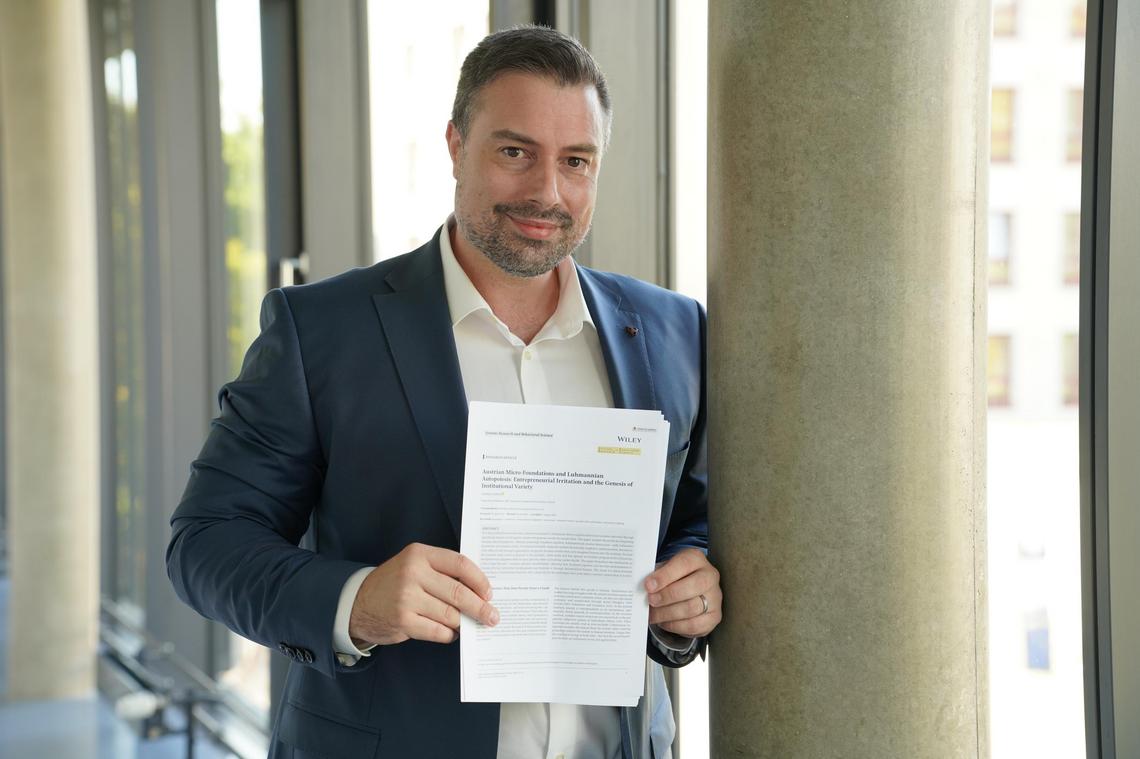
How does something genuinely new enter the economy? This fundamental question is the focus of a recent publication by Dr Amadeus Gabriel, Programme Director Transnational Programmes at IMC Krems, published in the renowned journal Systems Research and Behavioral Science. The paper, “Austrian Micro-Foundations and Luhmannian Autopoiesis: Entrepreneurial Irritation and the Genesis of Institutional Variety”, brings together two distinct theoretical perspectives: Austrian economics, with its focus on entrepreneurial creativity and decision-making under uncertainty, and the systems theory of sociologist Niklas Luhmann.
When Ideas Become Economic Reality
Luhmann describes the economy as a self-reproducing system of communication. Individual thoughts and ideas, in this view, exist outside the economic system. Austrian economics, by contrast, focuses on the acting individual: entrepreneurs develop ideas about possible futures and make decisions even though their consequences cannot be fully predicted.
The publication brings these two perspectives together. At its core is the concept of “entrepreneurial irritation”. According to this approach, new ideas do not enter the economy directly. Instead, they become effective through organisations that translate ideas into concrete decisions – for example, through investments, new contracts or the hiring of employees. In this way, they generate impulses to which the economic system can respond.
Particularly in the case of radical innovation, conventional calculation is not sufficient. When something is genuinely new, its future success cannot be reliably inferred from existing data. Entrepreneurial judgement therefore becomes crucial precisely where calculation reaches its limits.
Decentralised Finance as an Example of Institutional Change
The approach is illustrated by the rise of Decentralised Finance (DeFi) between 2018 and 2022. Protocols such as Compound and Aave enabled new forms of lending without traditional banks. Ideas that initially appeared unusual gave rise to new practices and expectations, which spread rapidly through positive feedback loops.
At the same time, the development demonstrated that innovation is also shaped by market selection. The dramatic collapses of Terra/Luna and FTX in 2022 illustrate how new institutional forms emerge, prove themselves or disappear again.
Implications for Business and Policy
The findings also have practical implications: innovation often fails within organisations before it has the opportunity to prove itself in the market. Excessive hierarchical control and the expectation that every new idea must be fully calculated and secured from the outset can limit the openness required for innovation.
For businesses, this means creating space for experimentation, keeping information channels open and allowing for uncertainty when pursuing genuinely novel initiatives. Sustainable impact does not arise simply from founding a new company or launching a new initiative, but when these developments lead to routines, standards and expectations that are subsequently adopted by others.
Publication: Gabriel, A. (2026). Austrian Micro-Foundations and Luhmannian Autopoiesis: Entrepreneurial Irritation and the Genesis of Institutional Variety. Systems Research and Behavioral Science.