
Julia Brunner, a graduate of the Medical and Pharmaceutical Biotechnology programme at IMC University of Applied Sciences Krems (IMC Krems), has received this year’s top ASciNA Award, the Junior Principal Investigator Award. Presented by the Austrian Federal Ministry of Women, Science and Research (BMFWF), the award recognises her research published in the prestigious journal Cell. The award ceremony took place in Vienna on 19 November 2026 as part of a joint event organised with the Austrian Marshall Plan Foundation (AMPF) and the scientific network Austrian Scientists and Scholars in North America (ASciNA). Lukas Altenburger and Matthäus Siebenhofer also received Young Scientist Awards.
Press
IMC graduate recognised for research at the highest international level
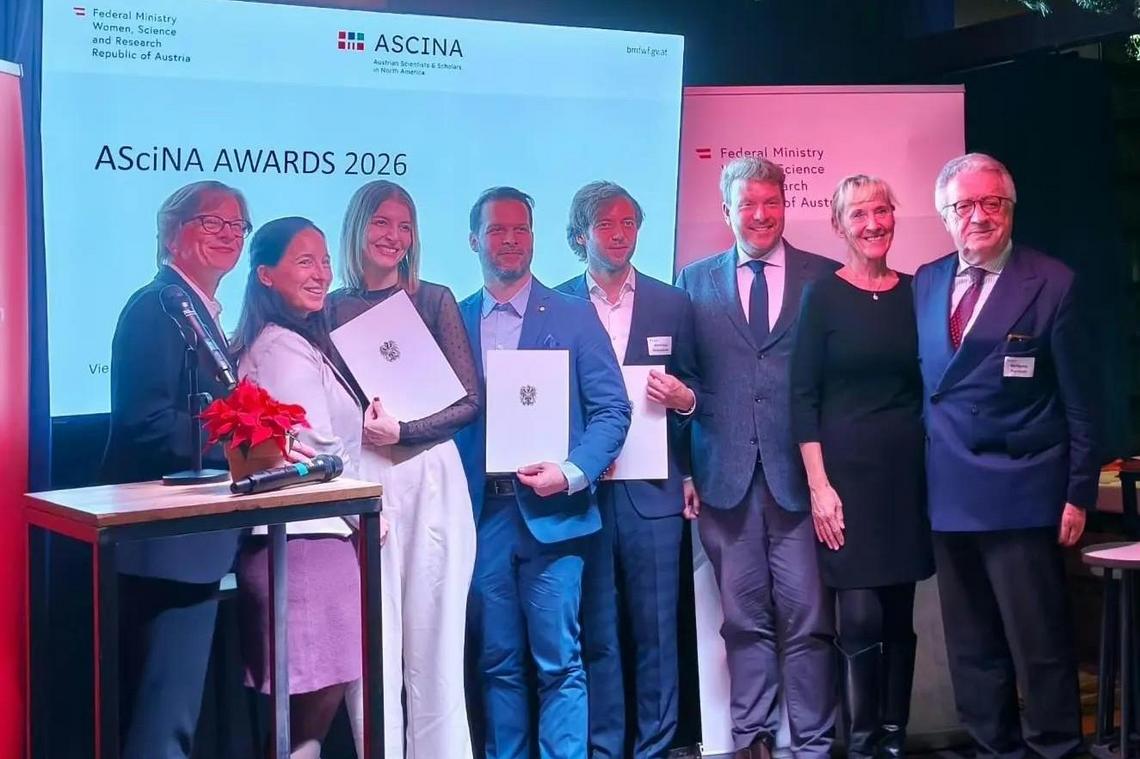
“Science thrives on open exchange, the pursuit of knowledge, new perspectives and the courage to push boundaries. Austrian researchers in North America make a valuable contribution in this regard, and the ASciNA Awards recognise their achievements,” emphasised Federal Minister Eva-Maria Holzleitner.
The BMFWF has presented the ASciNA Awards to early-career researchers since 2008. The Junior Principal Investigator Award carries prize money of €10,000. The award recipients are selected by an independent expert jury appointed by the Austrian Science Fund (FWF).
From IMC Krems to the German Cancer Research Center
Julia Brunner studied Medical and Pharmaceutical Biotechnology at IMC Krems, as well as Biomedical Science and Biotechnology at the University of Veterinary Medicine Vienna. She completed her PhD in Immunology at the Medical University of Vienna in 2020. From 2020 to 2026, she conducted research at Memorial Sloan Kettering Cancer Center in New York, in the laboratory of Lydia Finley. Since August 2026, she has headed the *Metabolic Networks and Dependencies* research group at the German Cancer Research Center (DKFZ) in Heidelberg.
The award-winning publication
The award recognises the paper “Citrate clearance is a major function of aconitase 2 in the canonical TCA cycle”, published in the scientific journal Cell in April 2026.
Metabolism supplies cells with the energy and building blocks they need to grow and divide. A central role is played by the citric acid cycle, discovered by Hans Krebs in 1937. Julia Brunner and her colleagues have now demonstrated that the cycle also helps break down excess metabolic products that could otherwise be harmful. When the enzyme ACO2, which normally processes citrate further, is absent, citrate accumulates in the mitochondria, triggering a stress response and slowing cell growth. Surprisingly, in mice lacking ACO2, the tissues most affected were not those with particularly high energy demands, but rather the kidney tubules. The findings show that healthy cells must not only produce metabolic compounds but also maintain a careful balance.
“Every year, it is impressive to see how many Austrian researchers succeed on the international stage and demonstrate the quality of their scientific work through outstanding publications,” said Christof Gattringer, President of the Austrian Science Fund (FWF).
About ASciNA
ASciNA (Austrian Scientists and Scholars in North America), the network of Austrian researchers and scholars in North America, was founded in Washington, D.C., in 2002 and now has around 1,400 members worldwide. ASciNA supports its members in the United States, Canada and Mexico, while also acting as a bridge between the Austrian research landscape and the North American research community.