
Austria’s Universities of Applied Sciences (UAS) are calling for the right to independently offer doctoral programmes. This would strengthen practice-oriented research, enhance international competitiveness, and prevent the migration of young researchers abroad. Examples from Germany show that independent doctoral programmes function successfully.
Press
Austria’s Universities of Applied Sciences seek the right to award doctorates
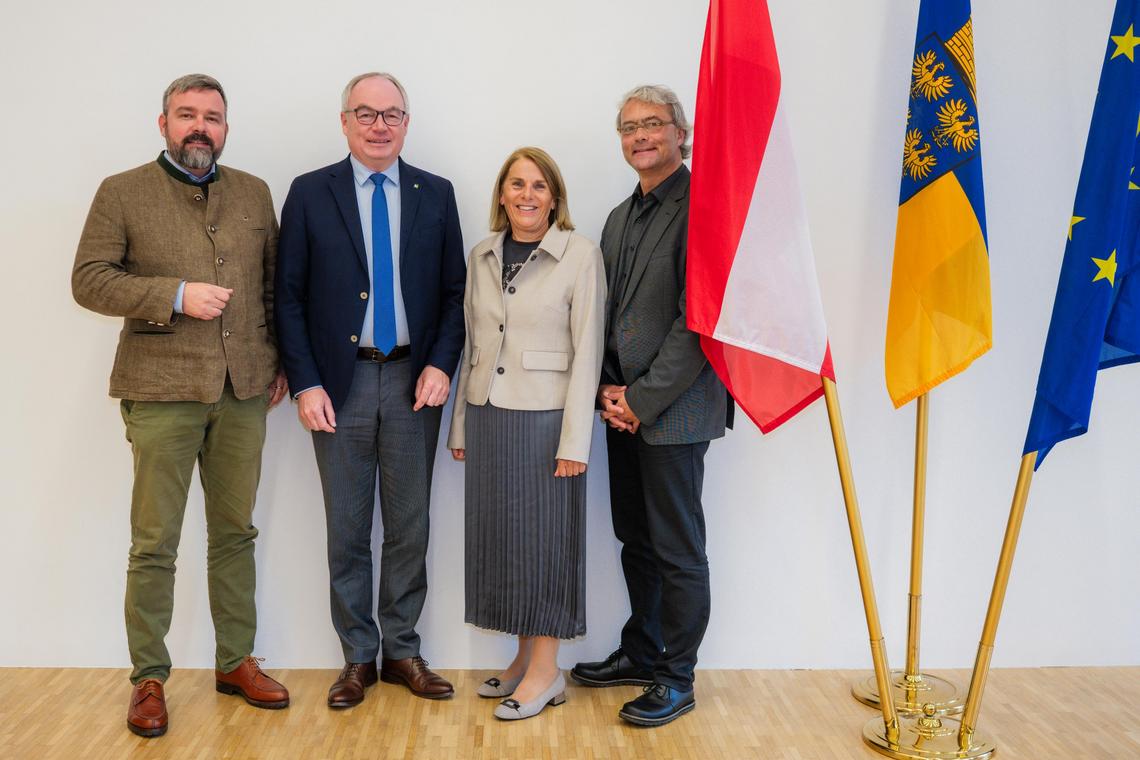
With more than 13,000 students, practice-oriented research and new degree programmes in computer science, rail technology, digital health, biotechnology and artificial intelligence, the Universities of Applied Sciences are shaping the future across Lower Austria. At a press event held today at Campus Krems, Deputy Governor Stephan Pernkopf, together with Ulrike Prommer, President of the UAS Conference and CEO of IMC Krems, Hannes Raffaseder, CEO of St. Pölten University of Applied Sciences, and Axel Schneeberger, CEO of Wiener Neustadt University of Applied Sciences, provided insights into new degree programmes, current developments, strategic priorities and the next steps needed to modernise Austria’s higher education system.
Lower Austria as a higher education region
“What was still a vision 25 years ago is today a reality: Lower Austria has become a higher education region,” said Deputy Governor Stephan Pernkopf. While in the past, students had to move to Vienna to study, today there are opportunities in all regions of Lower Austria. Pernkopf spoke of “clear growth”, calling it a “strong mandate for the future”. He emphasised the region’s “pioneering role in diversity”, noting that from the winter semester 2025/26, the range of degree programmes at the Universities of Applied Sciences will be expanded by seven new programmes, offering around 175 additional study places. In total, Lower Austria now offers 115 degree programmes with more than 13,000 study places – spread across three main campuses and five satellite locations.
The next logical step: the right to award doctorates
“The Universities of Applied Sciences respond to the needs of industry and address future-oriented topics – from digitalisation and mobility to biomedicine and sustainability,” Pernkopf stressed. Training people locally ensures that domestic companies have access to the skilled professionals they urgently require. “The next logical step is the right for Universities of Applied Sciences to award doctorates,” he underlined, adding that this is essential to retain talent, safeguard investment, and strengthen innovation and regional development.
The most important goal, he said, is to transfer research results into practice as quickly as possible so that they benefit society. Every doctoral project contributes to this. In Germany, 14 out of 16 federal states already grant the right to award doctorates; Pernkopf urged Austria to follow suit in order to avoid losing talent and falling behind competitively. “The Universities of Applied Sciences are a success story in Lower Austria,” he concluded. “Now it’s time to write the next chapter. The right to award doctorates is the key to ensuring that the best minds stay, conduct research and create new knowledge.”
He added: “Science and research have always built bridges. Granting Universities of Applied Sciences the right to award doctorates is, alongside the diversity of study opportunities, certainly an investment in our country and in our future. We want to offer young people the best possible opportunities.”
Lack of career prospects for young researchers – rapid implementation required
Ulrike Prommer, President of the UAS Conference and CEO of IMC Krems, reported a “very good start to the new academic year” and “several record figures”, including record student numbers – with IMC Krems currently hosting 3,850 students in Krems and 700 at its international locations. Since this academic year, three new master degree programmes have been introduced: OMICS Technologies and Data Science in Biomedicine, Sustainable Chemistry and Digital Processing, and Engineering Responsible AI Systems. Each comprises 120 ECTS credits and concludes with the award of a Master of Science in Engineering. The language of instruction is English “to remain competitive”, and the programmes can also be completed on a part-time basis.
During the summer months, IMC Krems invested one million euros in infrastructure. However, Prommer emphasised that there is still a lack of career perspective for young researchers. She reiterated the demand for the right to offer accredited doctoral programmes, noting that Universities of Applied Sciences already possess the necessary research infrastructure, clear thematic focus areas and excellent staff to develop high-quality doctoral models. She described this as a “logical further development of the existing institutional profile” and called for swift implementation so that Austria no longer leaves valuable research and innovation potential untapped.
Hannes Raffaseder, CEO of St. Pölten University of Applied Sciences, stated: “The entire UAS sector continues to boom.” St. Pölten UAS has increased its student numbers to more than 4,000, alongside growing research income. The institution is publishing in leading international journals and cooperating with numerous partners from industry and academia. Raffaseder highlighted two dual study programmes – Rail Vehicle Technology and Social Pedagogy – and noted record interest and application numbers. “We need the right to award doctorates for Universities of Applied Sciences,” he said, explaining that while European UASs are already competitive with the USA and China in basic research, “it is now time for the next step.”
Axel Schneeberger, CEO of Wiener Neustadt University of Applied Sciences, reported that the institution now has more than 4,500 students. This academic year, it launched a new bachelor degree programme in Computer Science and a new master degree programme in Sustainable Finance & Digital Transformation. Both are oversubscribed and taught in English – a first for Wiener Neustadt UAS, which, according to Schneeberger, reflects “a strong trend towards international education”. In research, the university focuses on artificial intelligence in agriculture (smart farming) at its Wieselburg campus, as well as on key technologies such as quantum sensing and satellite development at Wiener Neustadt. Schneeberger also underlined the importance of the right to award doctorates to prevent the loss of young researchers.
Text based on Amt der NÖ Landesregierung

