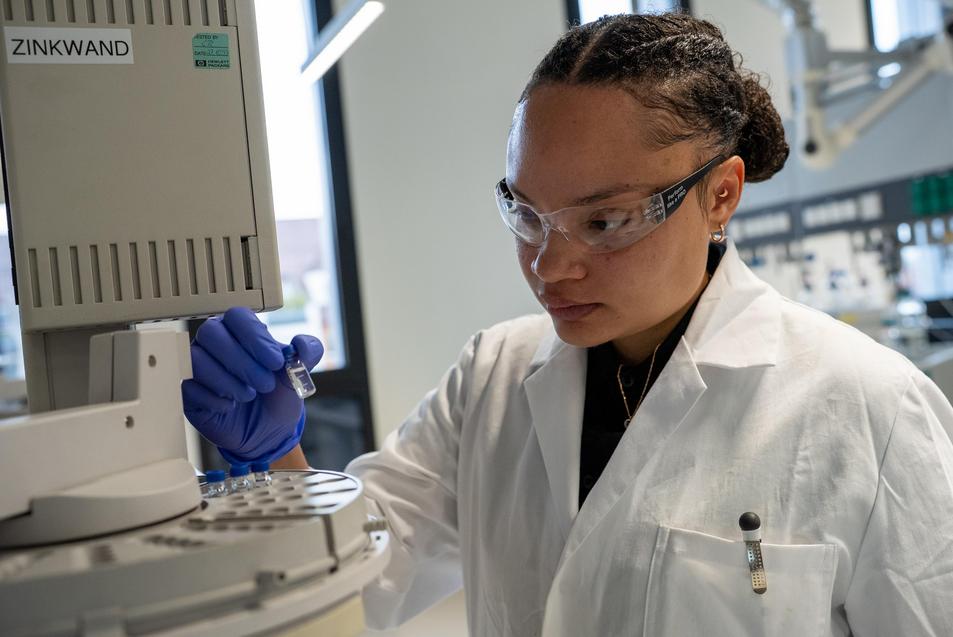
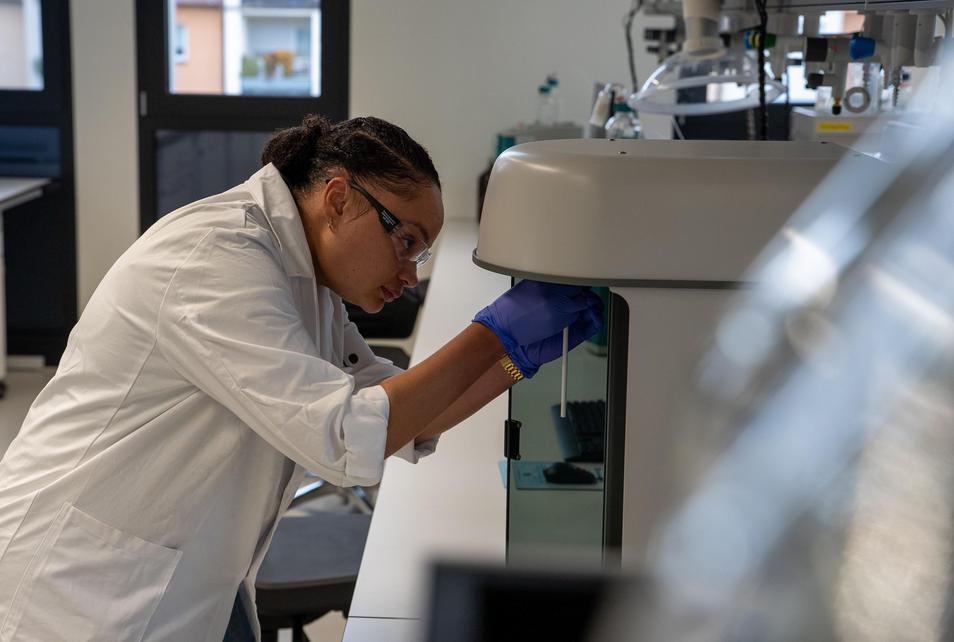
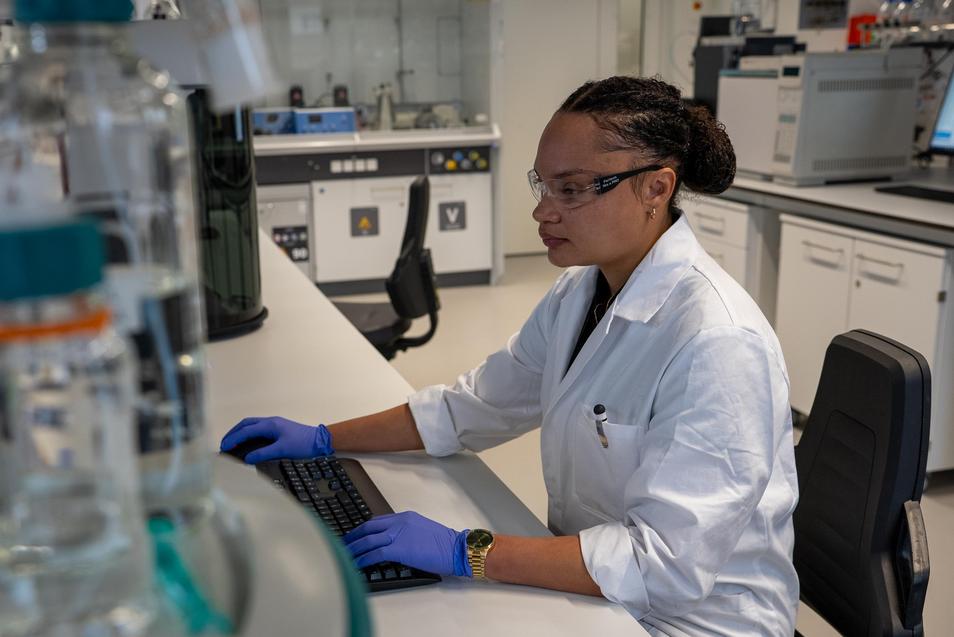
Chemist Christine Fiedler has recently joined the Applied Chemistry research team at IMC Krems. Her academic journey has taken her from the Caribbean to Austria, via Johannes Kepler University Linz and the Institute of Science and Technology Austria. Today, she combines her passion for materials science, nanotechnology and polymer chemistry with a drive to develop materials that could offer practical applications.
Press
A passion for chemistry and the curiosity to explore the world of materials
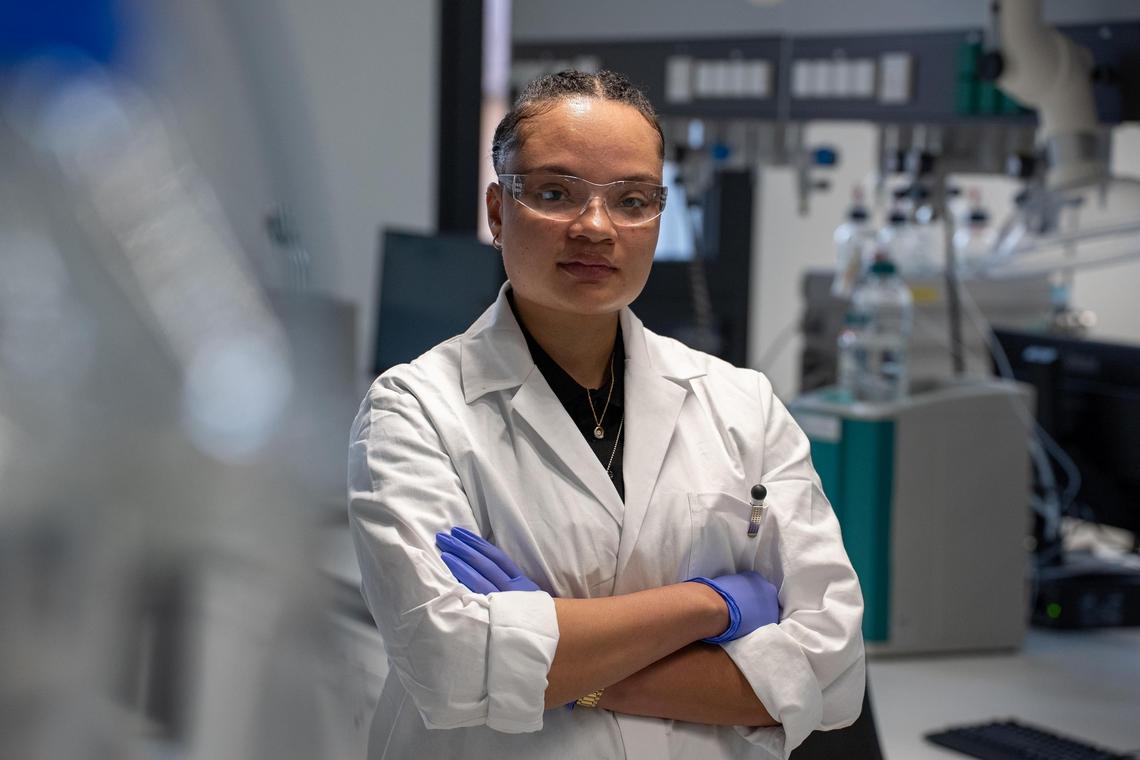
From the Caribbean to Austria's research community
Sometimes, a scientific career begins with a simple question: how does the world around us work? For Christine Fiedler, this curiosity was the starting point. Growing up in Barbados, she developed an interest in science during her school years. In 2016, she graduated with First Class Honours in Chemistry with Biochemistry from the University of the West Indies, Cave Hill. Her academic journey then took her to Austria, where she completed a master's degree in Polymer Chemistry at Johannes Kepler University Linz, exploring the development of functionalised micro- and nanomaterials.
In 2020, she began her PhD at the Institute of Science and Technology Austria (ISTA). Her research focused on solution-processed tin chalcogenides for thermoelectric applications, investigating how chemical composition, microstructure and defects influence the properties and performance of materials. She completed her PhD in 2026. Now, joining IMC Krems marks the beginning of a new chapter in her scientific career.
How the smallest changes can make a big difference
What fascinates Christine Fiedler most about materials research is the influence that the smallest structures can have on the properties of a material. Changes at the atomic and nanoscale can make a significant difference to how a material behaves. "The composition alone does not tell the whole story," she explains. Understanding how materials form, how their structures develop and how different elements are distributed within them is equally important.
At IMC Krems, she is working on the MIPSI project, which focuses on developing molecularly imprinted polymer-based materials for the selective detection of dopamine. The approach involves functionalising silica nanoparticles with specially designed polymer structures that can recognise a specific target molecule. In the longer term, the aim is to develop a straightforward sensing approach that could indicate the presence of dopamine through a visible response. For Fiedler, the appeal lies in bringing together fundamental chemical questions and the potential for practical applications.
Research, however, rarely follows a straight path – something she has come to appreciate. Planning experiments, preparing materials, taking measurements and analysing results all require patience and creativity. Results do not always match initial expectations. Yet, for Fiedler, this is precisely where research becomes interesting: unexpected findings can challenge existing assumptions and open up new avenues of investigation.
Making science accessible and creating opportunities
Alongside her enthusiasm for research, Christine Fiedler has developed a strong interest in science communication. Through her involvement in scientific conferences and communication initiatives, she discovered how much she enjoys making complex research understandable and inspiring others to engage with scientific topics.
Her own international journey has also shaped her perspective on science. Moving from Barbados to Austria has shown her how important access to education, scientific resources and opportunities can be. "Where you start should not determine how far you can go" is one of the beliefs that continues to motivate her.
At IMC Krems, she is looking forward to developing her research further, working across disciplines and helping make scientific knowledge visible and accessible beyond the laboratory. And what does she need to get her day off to a good start? A good coffee and a little time to ease into the morning. A fitting approach to research, too: staying curious, asking questions and making new discoveries one step at a time.
Christine Fiedler in a nutshell
- To me, research work is… curiosity put into practice and the process of turning questions into understanding.
- A role model for me is… anyone who challenges expectations, creates opportunities for others and uses their knowledge to make a difference.
- For the future, I wish for… a world where opportunities in science are accessible to everyone, regardless of where they come from.
- The greatest challenge I’ve faced in my life so far… building a life and career away from home while learning to navigate new environments and opportunities.
- I find inspiration… in people who think differently, ask questions and are not afraid to challenge the way things are done.
- In the morning, I need… a good coffee and a little time to get going.
- I would like to be… someone who makes a meaningful contribution to science and helps make it more accessible to others.
- I find relaxation… in spending time with the people I care about and going to the gym.
- I tackle difficult tasks by… breaking them down, asking questions and approaching them from different angles until I find a solution.
- I studied chemistry because… I wanted to understand how the world works at a fundamental level and how we can use that knowledge to solve problems.
- A place where I recharge… wherever I can feel at home, spend time with my loved ones and completely switch off.
- What I find exciting about research is… that you can spend years studying a subject and still discover something that changes how you understand it.